Ťažký štít, Mountain summit in High Tatras, Slovakia.
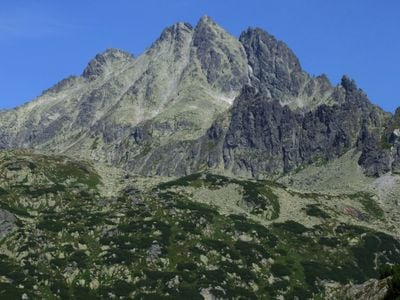
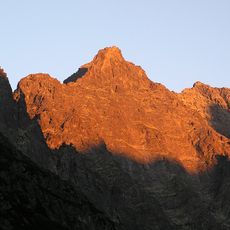
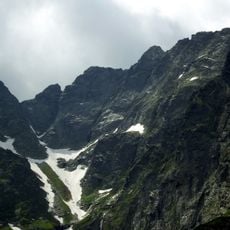
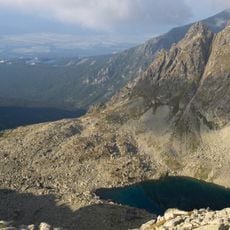
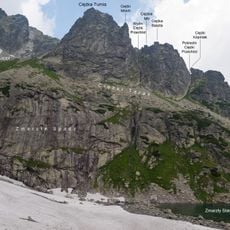
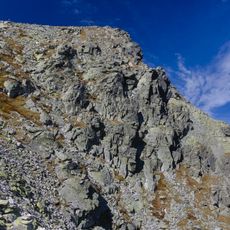
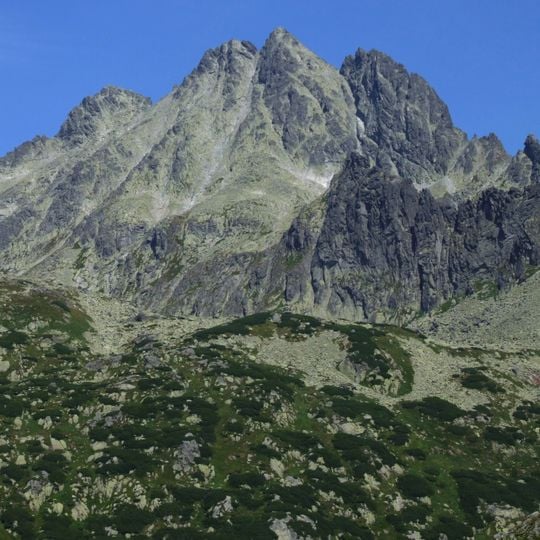
Ťažký štít is a 2,510 m granite summit in the main ridge of the High Tatras, between the Váha saddle and Vysoká. Its upper part is bare grey rock split into vertical ridges and gullies, with darker crags on the right-hand face and a pointed apex flanked by two lower shoulder ridges. Low dark green vegetation and pale boulders cover the base.
The first recorded ascent was made on 7 July 1904 by Ernst Dubke with guide Johann Franz senior, via the northwest ridge from the Váha saddle. The first winter ascent followed on 23 March 1913 by Lajos Károly Horn and Ernő Kátai. In 1932 W. Stanislawski and Marek Żuławski climbed the 400-metre northeast face, now rated V.
The name comes from Ťažká dolina, formerly called Česká dolina after a mistaken translation of the Goral word ciezky, meaning hard. Shepherds from Jurgov, Čierna Hora, Repisko and Lendak grazed cattle here in the 17th century. In 1888 František Dénes named the peak after Martin Róth, a professor and Tatra climber.
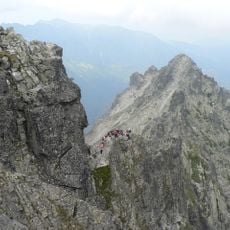
Climbing this peak demands experience and technical gear like ropes and climbing equipment due to the steep and exposed sections. Plan visits during summer months when weather is most stable and accessible.
The German and Hungarian names honour Martin Róth, a Tatra climber and tourism organiser, assigned by František Dénes in 1888. The Slovak name comes from the Ťažká valley, whose name mistranslated a Goral word for "heavy" and produced the erroneous variant Český štít, "Czech Peak".
The community of curious travelers
AroundUs brings together thousands of curated places, local tips, and hidden gems, enriched daily by 95,320 contributors worldwide.