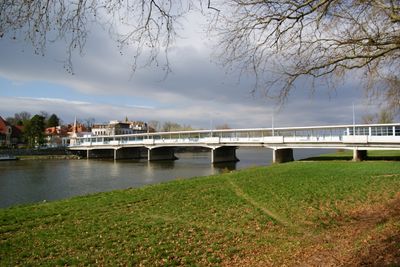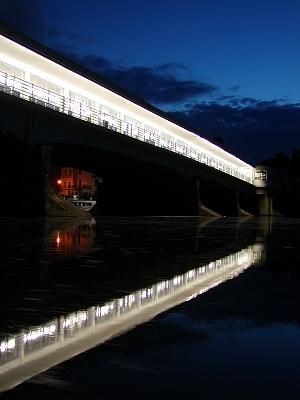
Kolonádový most, Covered pedestrian bridge in Piešťany, Slovakia
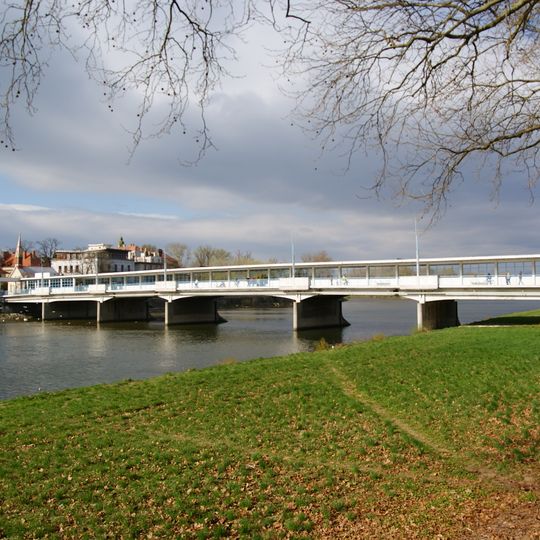
Kolonádový most is a covered bridge crossing the Váh River and connecting the town center of Piešťany to the spa island. The structure features glass-enclosed walkways that protect visitors while moving between the city and the thermal facilities.
Built in 1932 by architect Emil Belluš, the bridge was destroyed during World War II and reconstructed in 1956. The rebuilding preserved the original design and restored the connection between the city and the spa area.
The name 'kolonádový' refers to the bridge's role as a promenade and meeting place for spa guests, which architect Emil Belluš called a place for 'infanterists' — patients who walk. The Latin inscriptions were chosen by historian Daniel Rapant: the town side reads 'Saluberrimae Pistinienses Thermae' from a 1642 poem by Adam Trajan, the island side 'Surge et ambula' from Matthew 9:6.
The passage is weather-protected, making it easy to cross comfortably even during rain or cold. The bridge connects directly to the spa facilities, so you can move between the town and the thermal area without any detours.
A bronze statue of Barlolamač, designed by Robert Kühmayer, stands at the entrance and represents the healing powers of the place. This lesser-known figure quietly testifies to the spiritual dimension of the spa tradition.
The community of curious travelers
AroundUs brings together thousands of curated places, local tips, and hidden gems, enriched daily by 95,017 contributors worldwide.