Residence of Bukovinian and Dalmatian Metropolitans, Orthodox metropolitan residence in Chernivtsi, Ukraine
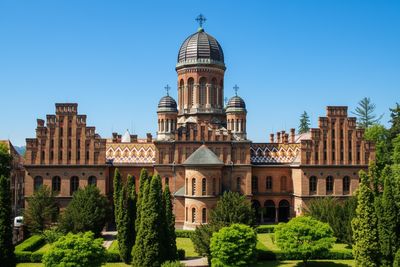
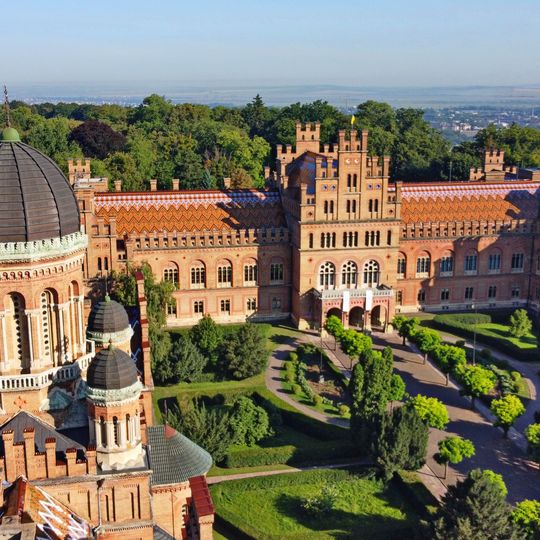
The Residence of Bukovinian and Dalmatian Metropolitans is an ensemble of red-brick buildings with patterned tile roofs arranged around a courtyard about 100 metres deep and 70 metres wide. The main residence, opposite the gate, contains the Chapel of St John the New of Suceava and the Synodal Hall, now the Marble Hall. To the left of the gate stand the former seminary and its Church of the Three Holy Hierarchs; the former monastery, with a clock tower, forms the left wing. The complex is set among trees and lawns.
Bishop Eugenie Hacman complained to Lviv in 1851–1852 about the undignified rented rooms, prompting a contest won by Josef Hlávka. Emperor Franz Joseph I approved the plan on 20 August 1863, and the cornerstone of the Chapel of St John the New of Suceava was laid on 6 July 1864. The complex cost 1,750,000 guilders, was consecrated in winter 1882/3, and on 28 November 1918 the Synodal Hall hosted the vote uniting Bukovina with Romania.
The complex's halls carry names from their original roles: the Synodal Hall, now the Marble Hall, kept portraits of Austrian monarchs by Epaminonda Bucevschi, while the Blue Hall was the metropolitan's library. The Red Hall's wall painting was likened by UNESCO to trimming in red Chinese silk. The seminary church holds murals by Karl Jobst.
The complex is now part of Chernivtsi National University and can be explored through guided tours. Visitors can walk through the historical halls, chapel, and gardens, with accessible pathways throughout the grounds.
The clock tower displays Stars of David, honoring the Jewish community's role in building this Orthodox complex. This symbolic detail shows how different religious communities worked together despite their differences.
The community of curious travelers
AroundUs brings together thousands of curated places, local tips, and hidden gems, enriched daily by 93,587 contributors worldwide.