Black House, Renaissance building in Market Square, Lviv, Ukraine
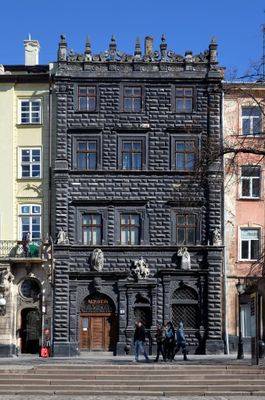
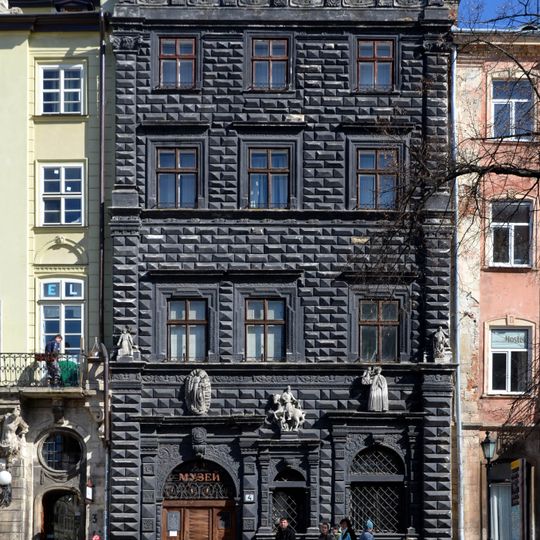
The Black House is a Renaissance building on Rynok Square in Lviv with a dark sandstone facade decorated across four stories with horizontal stone bands. The structure features classical proportions and ornamental details typical of Renaissance merchant buildings from this era.
Built in 1588–1589 in Renaissance style, probably with the involvement of Piotr Barbon; Władysław Łoziński wrongly attributed it to Piotr Krasowski. In 1596 it was raised by two storeys, and Jan Lorencowicz opened one of Lviv's first pharmacies here. The attic and portals were restored in 1875–1877, a fourth floor added in 1884, and the facade cleaned of plaster in 1911 under Edmund Żychowicz. The city bought it in 1926 and opened the Historical Museum of the City of Lviv on 22 September 1929.
The house takes its name from the blackened sandstone of its facade, darkened over centuries; a 20th-century legend claimed the color came from rubbing walnut-husk juice into the stone. Since 1929 it has housed the Lviv Historical Museum, and since 2019 a lapidarium of carved stone fragments from demolished Lviv buildings fills the vestibule and courtyard.
The entrance is the recessed arched wooden door on Rynok Square, marked by gold lettering above it. Since 14 November 2019 the lobby and inner courtyard hold the Lviv Lapidarium, showing carved stone fragments from demolished city buildings. The museum occupies the upper floors, reached by the staircase in the wing.
The black colour comes from lead white applied as a primer for polychrome painting, which oxidised over centuries; 1960s lore instead held that residents rubbed the facade with juice from green walnut husks. Art historian Władysław Łoziński wrongly credited the design to Piotr Krasowski. Since 14 November 2019 the vestibule and courtyard hold the Lviv Lapidarium, fragments of stone decoration from demolished city buildings.
The community of curious travelers
AroundUs brings together thousands of curated places, local tips, and hidden gems, enriched daily by 93,473 contributors worldwide.