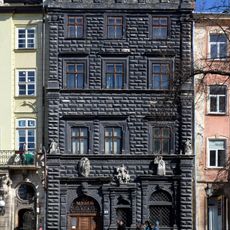
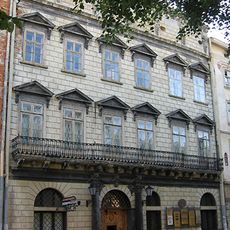
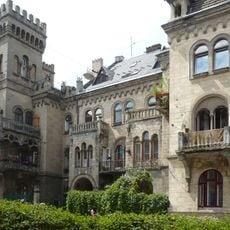
Lubomirski Palace, Baroque palace in Market Square, Lviv, Ukraine.
Lubomirski Palace is a Baroque palace built in the 1760s to a design by Jan de Witte for Prince Stanisław Lubomirski, standing on Lviv's Market Square. Its main façade, decorated by Sebastian Vessinger, faces the square, while the two other fronts are far less conspicuous. The palace occupies the full depth of the block, replacing several older houses, one of which had belonged to Szymon Szymonowic.
Stanisław Lubomirski bought two Sapieha townhouses and five houses on Ruska and Blacharska streets in 1763 and had them rebuilt as a palace to Jan de Witte's design. After the First Partition of Poland, from 1772 to 1826, it housed the Austrian governors of Galicia. In 1895 it was bought by the Ukrainian Prosvita society.
The palace takes its name from Prince Stanisław Lubomirski, who bought the site in 1763. In 1895 it was acquired by the Ukrainian Prosvita society, and on 30 June 1941 Yaroslav Stetsko proclaimed Ukraine's independence from its walls. Since 1975 it has housed the Museum of Ethnography and Artistic Crafts.
The main façade faces Market Square, while the other two fronts are far less conspicuous and reached from the side streets. Since 1975 the building has housed the Museum of Ethnography and Artistic Crafts, so the entrance is not on the square front itself. The neighbouring former palace of the Roman Catholic archbishops is worth a look.
On 30 June 1941, several days after Nazi Germany invaded the Soviet Union, Yaroslav Stetsko proclaimed Ukraine's independence in this building, which the Prosvita society had bought in 1895. The palace later housed the Museum of Ethnography and Artistic Crafts, founded there in 1975.
The community of curious travelers
AroundUs brings together thousands of curated places, local tips, and hidden gems, enriched daily by 94,227 contributors worldwide.