Fort Snelling, Military fort at Mississippi and Minnesota Rivers confluence, United States.
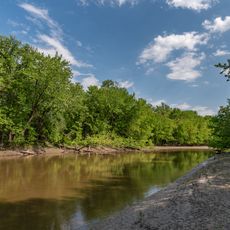
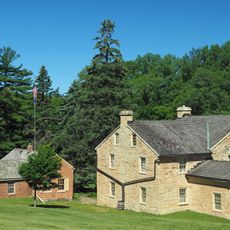
Fort Snelling stands on bluffs above the confluence of the Minnesota and Mississippi Rivers. The restored lower post centers on a long, single-storey white building with a dark grey pitched roof, evenly spaced dark doors and windows under small hoods, and two brick chimneys. To its right is a smaller pale tan stone building with a stepped gable and dark central doorway, flanked by low pale stone buildings with dark roofs, all facing a broad green lawn. Of the original lower post, only the round and hexagonal towers remain; the round tower is built of rough light tan and gray rectangular blocks, with a small square opening near the top and rows of narrow vertical slits.
The post was established in 1819 as an outpost of the US Army to secure American influence in the upper Mississippi valley. Over the decades it served as a base for western expeditions and played a role in treaties with indigenous peoples of the region.
Fort Snelling takes its name from Colonel Josiah Snelling, who commanded the post when construction finished in 1825; it had been begun in 1819 as Fort St. Anthony. The site is also called Bdóte, "where two rivers meet", a place of spiritual importance to the Dakota. The Minnesota Historical Society runs the restored fort as a museum village.
The site sits about 6 miles (10 km) south of downtown Saint Paul and is accessible via Minnesota State Highway 55. Tours and exhibit rooms are open regularly during summer months, though some buildings may close depending on weather conditions.
Within the walls, a small settlement once included enslaved people, even though Minnesota was part of free territory. The resulting legal cases later contributed to national debates about slavery in northern lands.
The community of curious travelers
AroundUs brings together thousands of curated places, local tips, and hidden gems, enriched daily by 94,165 contributors worldwide.