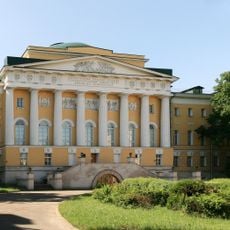
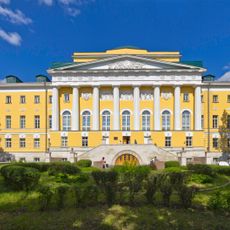
Moscow Manege, Exhibition hall at Manezhnaya Square, Moscow, Russia.
Moscow Manege is an exhibition building with classical architecture located at Manezhnaya Square in central Moscow. Its facades feature seven large arches that flood the interior with natural light and create multiple interconnected exhibition halls.
Agustín de Betancourt designed the building, erected in 1817 on the site of merchant stalls to mark five years since the 1812 victory, and it opened on 30 November 1817 with a parade. Joseph Bové gave the facades their Neoclassical exterior in 1824–1825. From 1831 it hosted exhibitions and public festivities; after 1917 it served as a barracks and a government car garage, and in 1957 it became the Central Exhibition Hall.
The building takes its name from its original role as a riding ground and today draws visitors from across the city to its exhibitions. Its classical style shapes how people experience the central plaza, with the space serving as a gathering point for cultural events and art presentations.
The building sits centrally on Manezhnaya Square and is easily reached by public transport from most areas of the city. The exhibition halls are accessible from the main entrance and provide ample space to explore both contemporary and classical art displays.
The attic was filled half a metre deep with makhorka tobacco to keep rodents and insects out of the wooden trusses. Staff say the tobacco was smoked by revolutionary soldiers after 1917 or during the hungry war years, and sawdust later replaced it. Foreign engineers travelled to Moscow to study the 45-metre span.
The community of curious travelers
AroundUs brings together thousands of curated places, local tips, and hidden gems, enriched daily by 93,127 contributors worldwide.