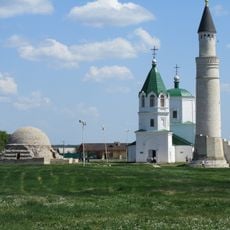
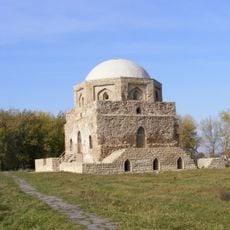
Bolghar Gord, Archaeological site in Tatarstan, Russia.
Bolghar Gord is an archaeological site along the Volga River with remains of defensive walls and buildings from several medieval centuries. The location reveals how a major settlement was organized with fortifications, religious structures, and other stone monuments.
Bolghar was founded by the Volga Bulgars in the 10th century and first mentioned by the Arab geographer al-Balkhi in 920. It was intermittently the capital of Volga Bulgaria alongside Bilyar and Nur-Suvar. In 1236 the Mongols sacked the city, and under the Golden Horde it became the first capital of that state. It was destroyed by Bulat-Timur in 1361, rebuilt, and finally destroyed in 1431 by the voivode Fyodor Pyostry, after which it was abandoned.
Tatars call the medieval capital Shahri Bolghar, Persian for "the City of Bolghar", and regard it as their ancient and religious capital. Since 2010 the Republican Fund for the Revival of Historical and Cultural Monuments, under Mintimer Shaimiev, has restored and rebuilt monuments and infrastructure here.
The complex stretches along the Volga terrace south of the modern town of Bolgar, with the main medieval monuments grouped on the central plateau. The reconstructed Great Minaret and the Cathedral Mosque foundation stand near the entrance area, while the Northern and Eastern mausoleums lie further across the site. Much of the ground is grass and uneven paving, so sturdy shoes help.
A museum here houses one of the world's largest printed Qurans, a rare religious manuscript. The book is kept in a dedicated memorial building and can be seen by visitors.
The community of curious travelers
AroundUs brings together thousands of curated places, local tips, and hidden gems, enriched daily by 94,141 contributors worldwide.