Nikitsky Convent, Orthodox monastery in central Moscow, Russia
Nikitsky Convent was a Russian Orthodox nunnery at the corner of Bolshaya Nikitskaya Street and Bolshoy Kislovsky Lane in Moscow, founded in 1582 and demolished in the 1930s. Its main church, the Nikitsky Cathedral, combined a 16th-century core of Italian-style brick with 17th- to 19th-century rebuildings. Only a cell building at Bolshoy Kislovsky Lane 10 and a fragment of the south wall survive.
Founded in 1582 by boyar Nikita Romanovich Zakharin-Yuryev at an earlier church of Saint Nicetas, the convent was rebuilt after a 1682 fire. In 1812 French troops sacked it and fire damaged the buildings; Archbishop Augustine proposed abolishing it, but it was restored with private donations. The community was dissolved in the early 1920s, the churches closed in 1929, and the buildings were demolished in the 1930s for the first Moscow Metro traction substation.
The convent gave its name to Bolshaya and Malaya Nikitskaya streets, Nikitsky Lane and Nikitsky Gate. Its patron was Saint Nicetas the Goth, whose relic was kept here until the revolution. In the 1920s the bell-ringer K. K. Saradzhev rang the convent bells.
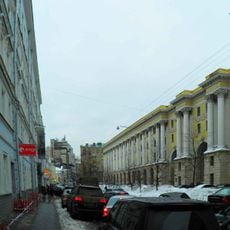
The convent no longer exists: its buildings were demolished in the 1930s and the first Moscow Metro traction substation, designed by D. F. Fridman, stands on the site at Bolshaya Nikitskaya Street and Bolshy Kislovsky Lane. What survives is the cell building at Bolshoy Kislovsky Lane, 10, and a small fragment of the south wall, visible from the street. Look for these remains rather than a monastery entrance.
The convent was demolished in the 1930s; on its site stands the first traction substation of the Moscow Metro, built to the design of architect D. F. Fridman. Only a cell building at Bolshoy Kislovsky Lane 10 and a fragment of the south wall survive. In the 1920s the bell ringer K. K. Saradzhev rang the convent bells.
The community of curious travelers
AroundUs brings together thousands of curated places, local tips, and hidden gems, enriched daily by 94,592 contributors worldwide.