Karlaman Cave, Natural monument and protected area in Bashkortostan region, Russia.
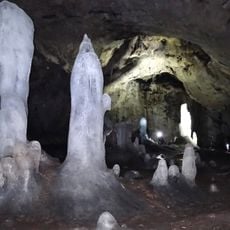
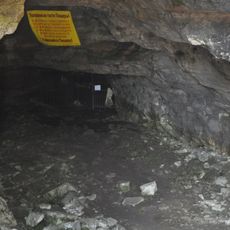
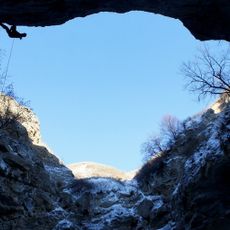
Karlaman Cave is a natural monument in Karmaskalinsky District, Bashkortostan, formed at the intersection of vertical and horizontal tectonic fissures. Its surviving entrance, after an L-shaped bend, leads into a wide tunnel with vertical walls and a nearly horizontal ceiling. Passages are 2 to 12 metres wide and 5 to 10 metres high; the cave is 198 metres long (some sources say 269), with an area of 1,153 square metres and a volume of 1,970 cubic metres. The walls and ceiling show corrosion grooves and cavities, and the floor is clay.
The cave is a protected natural monument of Bashkortostan, a status granted in 1965. It formed at the crossing of a vertical and a horizontal tectonic fissure in gypsum rock. Its passages were surveyed and catalogued in speleological reference works on the caves of the Urals and Cis-Urals.
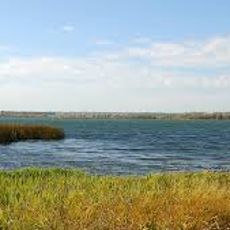
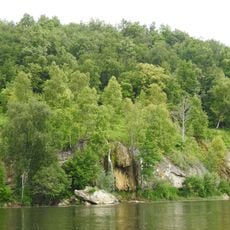
The cave lies at the foot of a gypsum cliff that locals call Ulu-Tau, Bashkir for "Great Mountain". The cave itself takes its name from the Karlaman stream, a karst watercourse whose basin the cave sits in, about 3 km from the village of Karlaman. The surrounding steppe is noted for rare feather grasses and other protected plants.
Access to the cave involves traveling on a single-lane dirt road that can be difficult during wet seasons. Wear sturdy footwear and bring a light source for safe navigation through the passages.
Near the cave a dry valley marks the course of the Sagylelga, an underground stream that no longer flows on the surface. In the local rock visitors can find fossil molluscs, and the surrounding steppe grows feather grasses and other rare plants.
The community of curious travelers
AroundUs brings together thousands of curated places, local tips, and hidden gems, enriched daily by 94,393 contributors worldwide.