Literatorskie mostki, Literary memorial site in Volkovsky District, Saint Petersburg, Russia
Literatorskie Mostki is a section of the Volkovskoye Cemetery in St. Petersburg, turned into a museum-necropolis. Its paths lead past about 500 tombstones, among them the grey granite monument to Dmitri Mendeleev: a tall stone cross on a tapering base, its face framed by rough-hewn granite around a smooth reddish-brown oval panel with gold Cyrillic lettering.
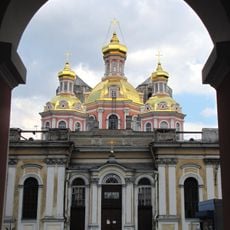
The cemetery was founded by Senate decree on 11 May 1756 in the village of Volkovo; wooden boards, or mostki, were laid over its swampy paths. The literary tradition began in 1802 with the burial of Alexander Radishchev near the Church of the Resurrection. In 1935 the section became a department of the State Museum of Urban Sculpture, and remains of writers such as Alexander Blok and Ivan Goncharov were moved here from cemeteries slated for destruction.
The name comes from the wooden boards (mostki) once laid over the muddy paths of Volkovskoye Cemetery. Since the 19th century, burial here has been a mark of public recognition for writers; the graves of Belinsky, Dobrolyubov and Pisarev lie side by side. The necropolis also holds the graves of Lenin's mother Maria Ulyanova and his sisters Anna and Olga.
The site is accessible year-round and welcomes visitors without an entrance fee. Wear comfortable shoes for walking the pathways, and plan time to explore the different monuments at a relaxed pace.
The name "mostki" comes from the wooden boards laid over the swampy ground so visitors could reach the graves without soiling their shoes. The cemetery itself was founded by a Senate decree of 11 May 1756 in the village of Volkovo, whose name is linked to the wolves that once roamed there.
The community of curious travelers
AroundUs brings together thousands of curated places, local tips, and hidden gems, enriched daily by 94,062 contributors worldwide.