Chapayev monument, Military monument near Sosnovka Park, Saint Petersburg, Russia
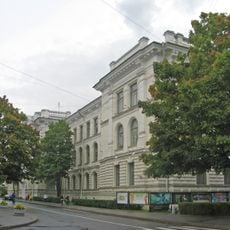
Chapayev monument is a bronze sculptural group in Saint Petersburg, standing before the main facade of the Budyonny Military Signals Academy. It rises 4.5 m in total: a 3 m equestrian figure of divisional commander Vasily Chapayev on a rearing horse, surrounded by seven figures — a commissar, a Baltic sailor, an old soldier, a woman worker, a partisan, a Bashkir and a Red Army soldier — all modelled from veterans of his division. The 12-tonne bronze group stands on a stepped granite pedestal 1.3 m high, tilted so the figures seem to move forward and upward toward the city centre.
Matvey Manizer modelled the sculptural group in 1932 for Samara (then Kuybyshev), using photographs of Chapayev division veterans and the commander's son Alexander as the model for Chapayev. At Sergey Kirov's initiative a second bronze casting was made in 1933–1934 in Manizer's workshop on Pesochaya Street for Leningrad. Moved between yards on Krestovsky Island and Yelagin Island, it was hauled into the courtyard of the Communications Academy in winter 1942–1943 and mounted on a log pedestal by cadets — the only monument erected in Leningrad during the siege. In 1968 it was turned 90° on a new granite pedestal by architect Nikolay Brovkin and unveiled on 4 November.
The seven figures around Chapayev's horse are portraits of real veterans of his division: a commissar, a Baltic sailor, an old soldier, a factory woman, a partisan, a Bashkir and a Red Army soldier. Manizer studied photographs and met survivors to reproduce their faces. The square in front of the monument hosts city events and political rallies.
The monument stands in the courtyard of the Budyonny Military Academy of Communications, facing the main building's facade. Since 2014 the protected heritage area around it has been closed to close approach; entry is free on holidays, when ceremonies and military-patriotic events take place on the plaza. The sculpture was turned 90° when mounted on its granite base, so the group now moves toward the city centre.
The son of the depicted commander served as the physical model for the sculptor when creating the main figure's facial features and posture. This personal connection between family and artistic representation makes the work particularly interesting from an artistic perspective.
The community of curious travelers
AroundUs brings together thousands of curated places, local tips, and hidden gems, enriched daily by 94,405 contributors worldwide.