Rostov railway drawbridge, Railway vertical-lift bridge in Rostov-on-Don, Russia
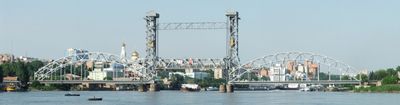
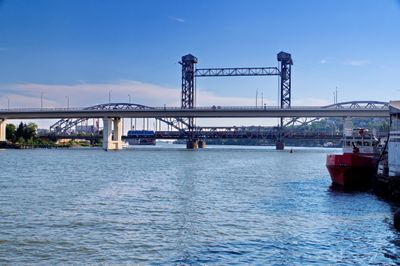
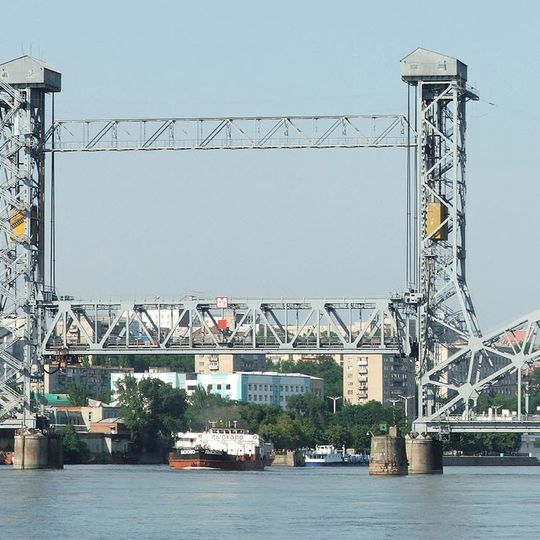
The Rostov railway drawbridge is a 300-meter structure spanning the Don River with two railway tracks and a central lifting section for ships to pass through. It connects Rostov Glavny and Zarechnaya stations and moves aside when larger vessels need to travel on the river below.
Engineers designed this double-track version in 1917 to replace an older single-track bridge that once stood at this location. After suffering damage during World War II, it was completely rebuilt between 1949 and 1952.
Rostov residents nicknamed the 1917 bridge the "American bridge" because its parts were ordered, made and shipped from the United States. The name stuck even though the lifting mechanism was designed in Gustave Eiffel's studio. The present 1949–1952 bridge, built on the site of the wartime "littered" bridge, kept the nickname.
The bridge carries the main passenger line between Rostov Glavny and Zarechnaya stations, so it is seen most easily from a train crossing it or from the banks near the mouth of the Temernik. The lifting span sits between the two lattice towers; the 1945 bridge's piers still stand in the water nearby. The span is raised for vessels, so a crossing can pause.
This structure underwent multiple reconstructions over its lifetime, not just the major rebuild after World War II. These ongoing improvements show how essential this crossing remained for the region through different periods.
The community of curious travelers
AroundUs brings together thousands of curated places, local tips, and hidden gems, enriched daily by 94,121 contributors worldwide.