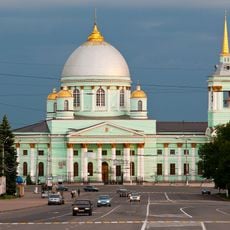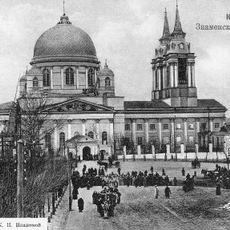
Cathedral of the Theotokos of Kazan and Saint Sergius of Radonezh, Orthodox cathedral in Kursk, Russia
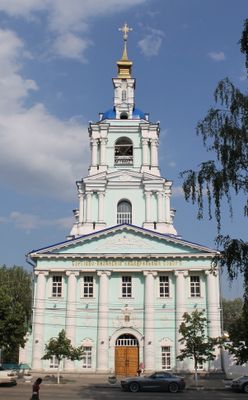
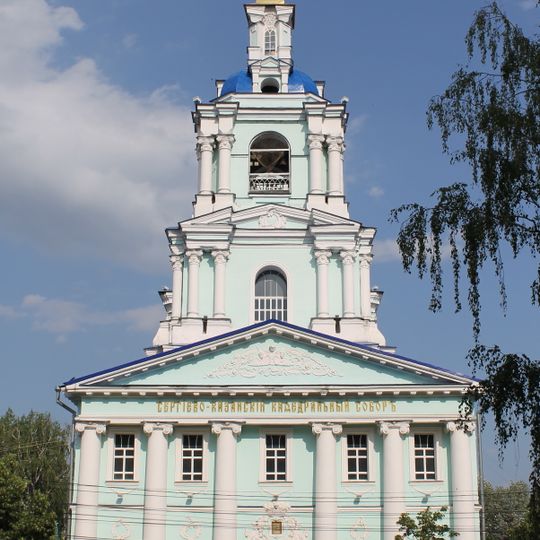
The Cathedral of the Theotokos of Kazan and Saint Sergius of Radonezh is a two-storey stone church built in the Elizabethan Baroque style, with a pale mint-green facade and white trim. Its lower block carries a wide triangular pediment above six white columns and five tall windows, with a gold inscription naming the cathedral. A tiered white bell tower with arched openings, a visible bell, a small blue dome and a cross rises above. In plan it is a rectangle about 16 m wide and 33 m long with a five-sided altar apse.
A wooden church of Saint Sergius stood here from at least 1718 until it burned in 1751; a Kazan icon found intact in the ashes led parishioners to build a two-storey stone church in 1752–1778, funded by merchant Karp Pervyshev and contracted by Isidor Moshin, whose widow Agafya completed it. The lower church was consecrated in 1762 and the upper in 1778. In 1833 the cathedral became the seat of the bishopric moved from Belgorod; it was closed from 1934 to 1942 and housed an art gallery and anti-religious museum.
The cathedral's name links the lower Church of St. Sergius of Radonezh, consecrated in 1762, with the upper Church of the Kazan Icon, consecrated in 1778. The upper church holds a 18-metre gilded carved iconostasis made in the 18th century by unnamed serf woodcarvers. The building is an active Orthodox church and a federal architectural monument.
The cathedral stands at the corner of Gorky Street (formerly Sergievskaya) and Mozhayskaya Street in Kursk's Central District. The lower St. Sergius church is heated, while the upper Kazan church is unheated. A separate Empire-style stair block added in 1837 by the city architect Groznov now leads to the upper church, replacing the original twin outdoor cast-iron staircases.
The upper church's 18-metre gilded carved iconostasis was made in the 18th century by unnamed serf woodcarvers, and the 16-year gap between the consecration of the lower church (1762) and the upper one (1778) is explained by the long work on it.
The community of curious travelers
AroundUs brings together thousands of curated places, local tips, and hidden gems, enriched daily by 93,240 contributors worldwide.