Cathedral of Our Lady of "The Omen", Eastern Orthodox cathedral in Kursk, Russia
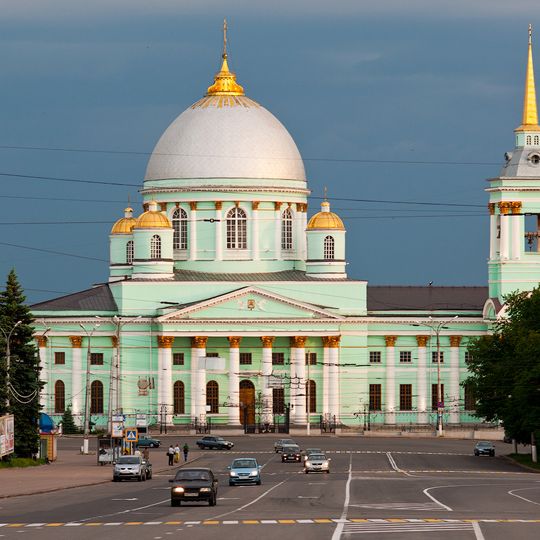
The Cathedral of Our Lady of "The Omen" is a classicist Orthodox church in central Kursk, built 1816–1826 as a monument to the 1812 victory. Its mint-green walls with white column details carry a wide white dome on a drum of tall arched windows, crowned by a small gold dome and cross, with four smaller gold domes at the corners. A six-column portico with triangular pediment faces front above tall arched windows, and a separate mint-green bell tower with a slender gold spire rises to the right.
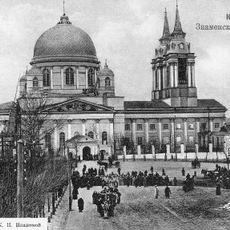
The present cathedral was laid on 4 (16) June 1816 as a monument to the 1812 victory over Napoleon and consecrated in 1826, replacing an earlier stone church of 1649–1680 on the same spot. In 1832 it became the cathedral of the Kursk eparchy. Closed under Soviet rule, it housed the Oktyabr cinema from 1937 to 1992, was badly damaged by fire in 1943 and rebuilt in 1956.
The cathedral's name comes from the Kursk Root Icon of the Mother of God "The Omen", which was kept here for a long time. Every year a cross procession carried the icon from the cathedral to the Kursk Root Hermitage. The main iconostasis was cast in iron and gilded, with icons painted by Karl Bryullov.
The church stands within the Znamensky Monastery complex in Kursk's historic center and is easily accessible on foot. Visitors should note that it functions as an active place of worship, so respectful dress and behavior are expected.
The main iconostasis is cast in gilded iron, while the side altars have wooden iconostases; the icons in the main one were painted by Karl Bryullov. In the drum beneath the main dome, 23 pictures are pasted on the walls instead of frescoes. Before the revolution the cathedral was among the ten largest Orthodox churches in Russia and could hold 5,000 worshippers at once.
The community of curious travelers
AroundUs brings together thousands of curated places, local tips, and hidden gems, enriched daily by 94,351 contributors worldwide.