See the monuments around you in AROpen chests in the app
Around Us is built for your phone — point your camera at the streets and discover the monuments and places around you in augmented reality.Around Us is built for your phone — chests unlock when you walk, explore and capture nearby places.
The churches with onion domes and the fortified kremlins of Moscow and the Golden Ring show the political and religious power of Russia since the Middle Ages.
Moscow and the Golden Ring form a historic region in central Russia where you can follow the traces of political and religious power through the centuries. Moscow itself is dominated by the Kremlin, an old fortress that became the seat of government, and by Red Square, where the Cathedral of Saint Basil the Blessed stands with its nine colored onion domes, along with the white, towering Cathedral of Christ the Saviour. A few miles (kilometers) from the capital, you will find monasteries like the Trinity Lavra of Saint Sergius, a major spiritual center, and the Novodevichy Convent, a fortified religious complex listed as a UNESCO heritage site.
Around Moscow lies the Golden Ring, a chain of old towns founded between the 12th and 14th centuries. Each of these towns tells a part of Russian history: Rostov Veliky with its kremlin and strong walls, Yaroslavl at the meeting point of two rivers with its 17th-century churches, Kostroma with a well-organized historic center, Suzdal with its preserved walls and its cathedral with blue domes decorated with stars, and Vladimir with its 12th-century Golden Gate. Along the way, you will also discover isolated churches like the Church of the Intercession on the Nerl, a small white medieval building surrounded by meadows.
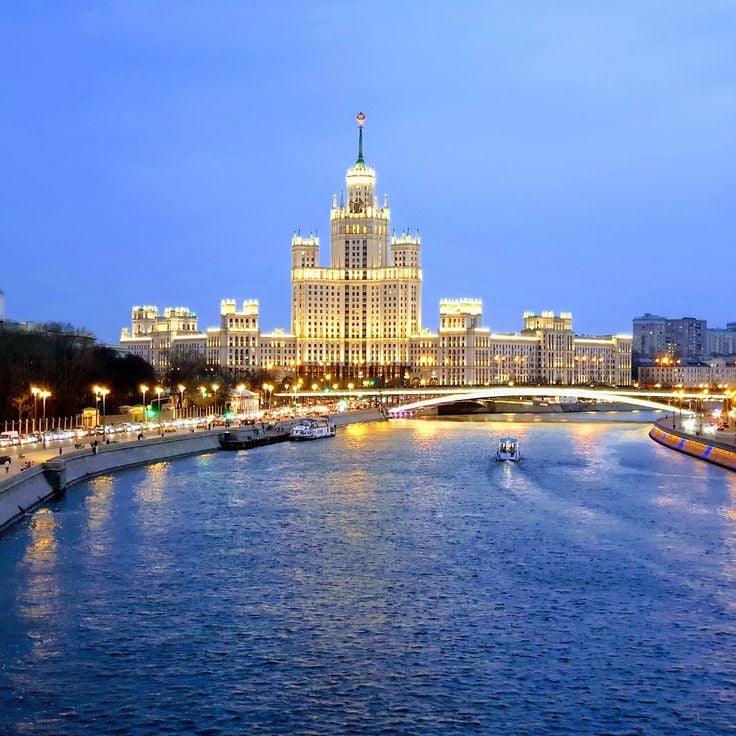
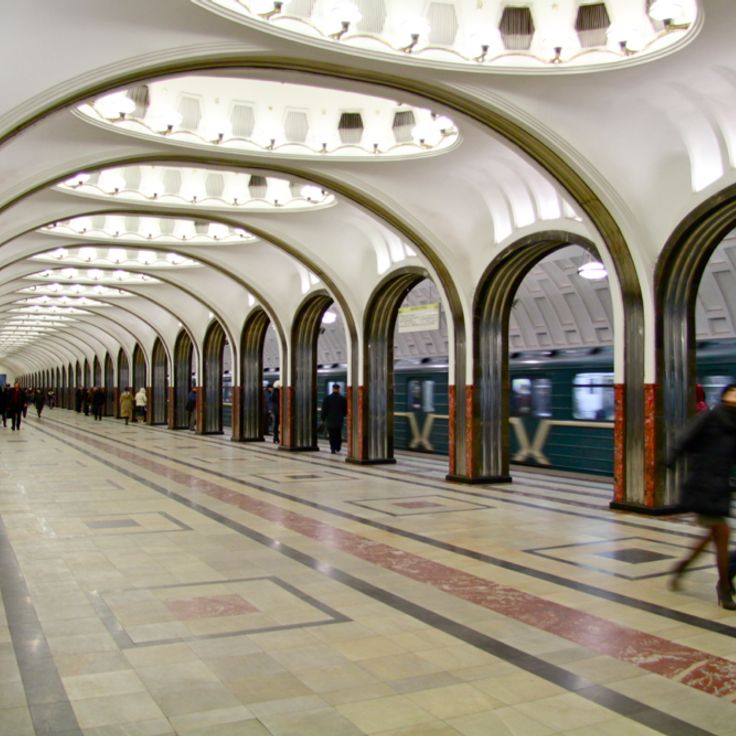
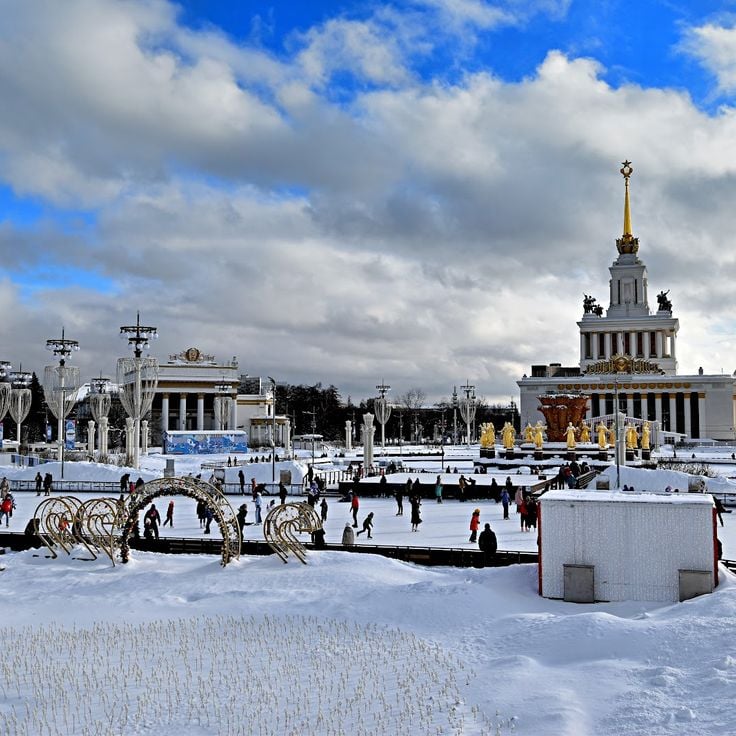
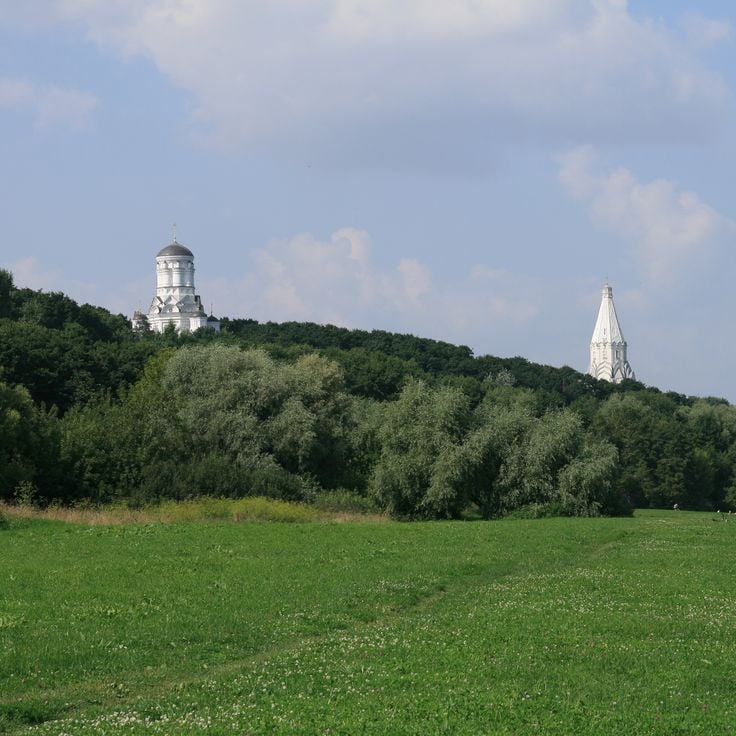
In Moscow's museums like the Tretyakov Gallery and the Armory Palace, you will see the collections of the Russian empire: paintings by masters, gilded carriages and precious objects of the tsars. Next to these old monuments, the Moscow metro offers a different experience, with stations decorated like underground galleries. These sites and city landscapes, from Zaryadye Park to VDNKh and the royal estate of Kolomenskoye, together tell the political, religious and cultural history of Russia from the Middle Ages to today.
The churches with onion domes and the fortified kremlins of Moscow and the Golden Ring show the political and religious power of Russia since the Middle Ages.
Moscow and the Golden Ring form a historic region in central Russia where you can follow the traces of political and religious power through the centuries. Moscow itself is dominated by the Kremlin, an old fortress that became the seat of government, and by Red Square, where the Cathedral of Saint Basil the Blessed stands with its nine colored onion domes, along with the white, towering Cathedral of Christ the Saviour. A few miles (kilometers) from the capital, you will find monasteries like the Trinity Lavra of Saint Sergius, a major spiritual center, and the Novodevichy Convent, a fortified religious complex listed as a UNESCO heritage site.
Around Moscow lies the Golden Ring, a chain of old towns founded between the 12th and 14th centuries. Each of these towns tells a part of Russian history: Rostov Veliky with its kremlin and strong walls, Yaroslavl at the meeting point of two rivers with its 17th-century churches, Kostroma with a well-organized historic center, Suzdal with its preserved walls and its cathedral with blue domes decorated with stars, and Vladimir with its 12th-century Golden Gate. Along the way, you will also discover isolated churches like the Church of the Intercession on the Nerl, a small white medieval building surrounded by meadows.
In Moscow's museums like the Tretyakov Gallery and the Armory Palace, you will see the collections of the Russian empire: paintings by masters, gilded carriages and precious objects of the tsars. Next to these old monuments, the Moscow metro offers a different experience, with stations decorated like underground galleries. These sites and city landscapes, from Zaryadye Park to VDNKh and the royal estate of Kolomenskoye, together tell the political, religious and cultural history of Russia from the Middle Ages to today.
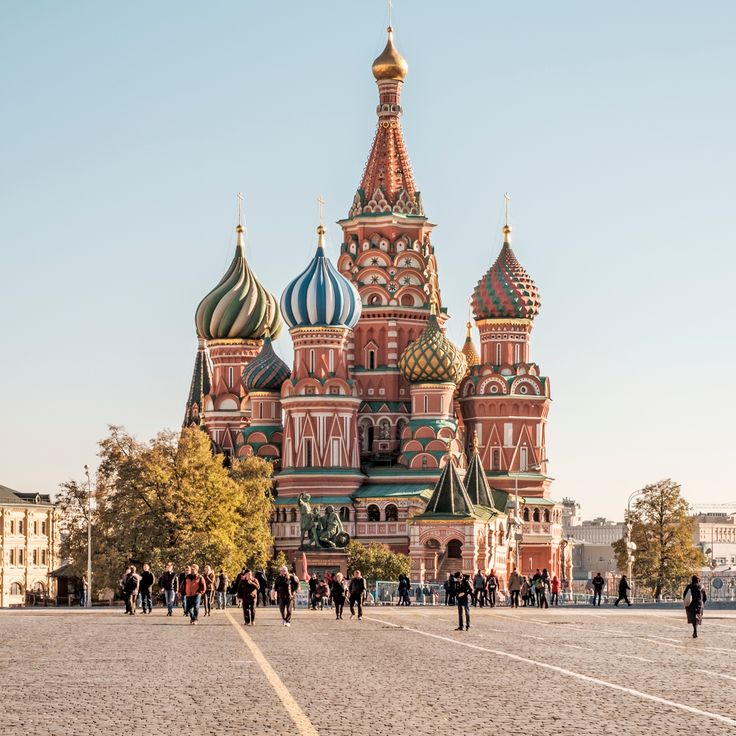
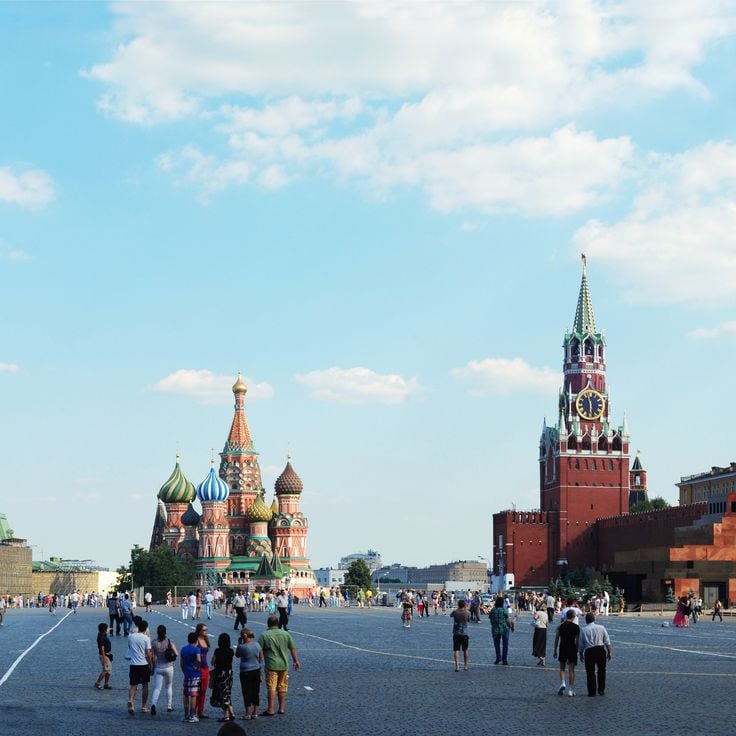
Red Square is the historical center of Moscow. It sits just beside the Kremlin and is bordered by buildings that have shaped Russian history for centuries. On one side stands Saint Basil's Cathedral with its nine colorful onion domes, on another the long facade of the GUM department store. The square has hosted parades, markets, and public gatherings, and walking across its cobblestones gives a strong sense of how much of Russia's story has played out in this one place.
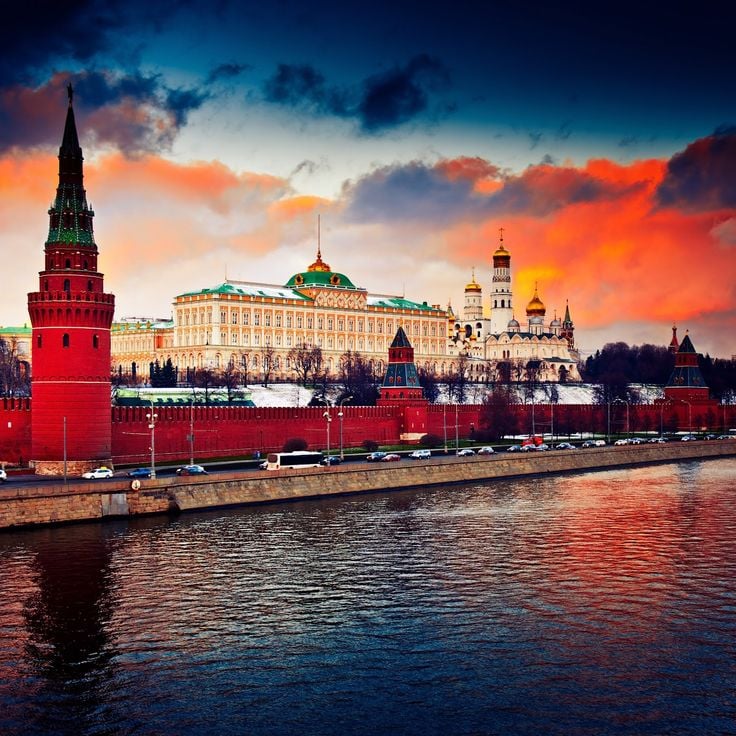
The Moscow Kremlin is the historical core of the Russian capital. Behind its red brick walls stand cathedrals, palaces, and government buildings side by side. You can see gilded domes, cobbled courtyards, and structures from many different periods. For centuries, it was home to the tsar and the patriarch, and today it remains the seat of the Russian president.
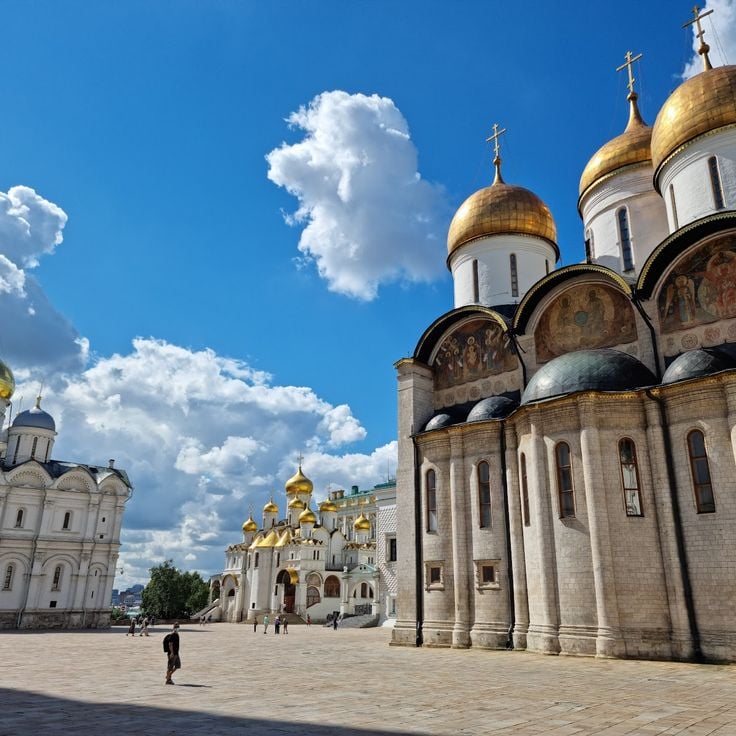
The Cathedral of the Dormition inside the Kremlin is where the Russian tsars were crowned for centuries. Built in the 15th century, it is one of the oldest churches in Moscow. Its white walls and golden domes stand at the heart of the Kremlin complex. Inside, you can see old icons and frescoes that cover almost every surface, giving a sense of how central this place was to Russian religious and political life.
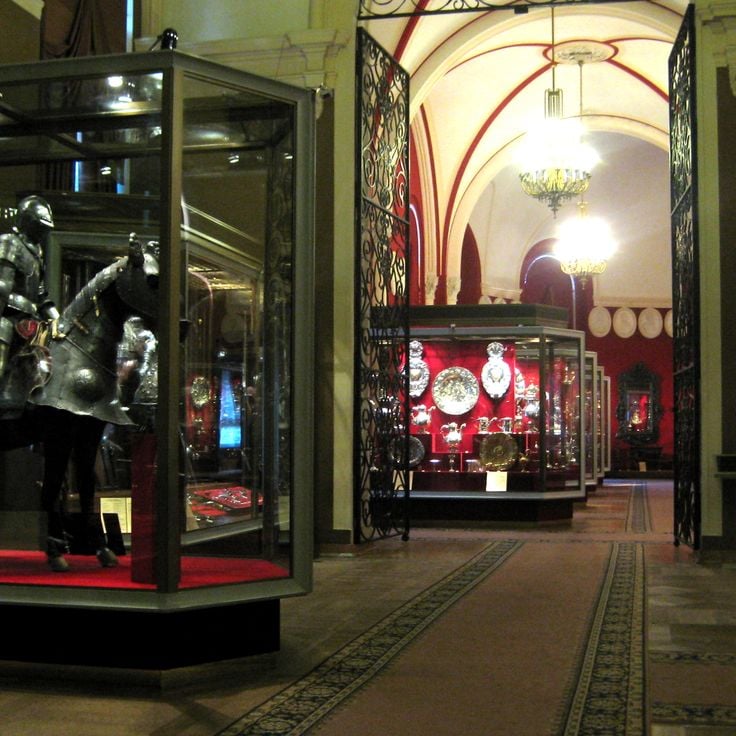
The Armory Palace sits inside the Moscow Kremlin and holds the imperial collections of the Russian tsars. Visitors can see crowns, gilded carriages, weapons and precious objects gathered over centuries of royal life. The rooms give a clear sense of how Russian rulers displayed their wealth and power.
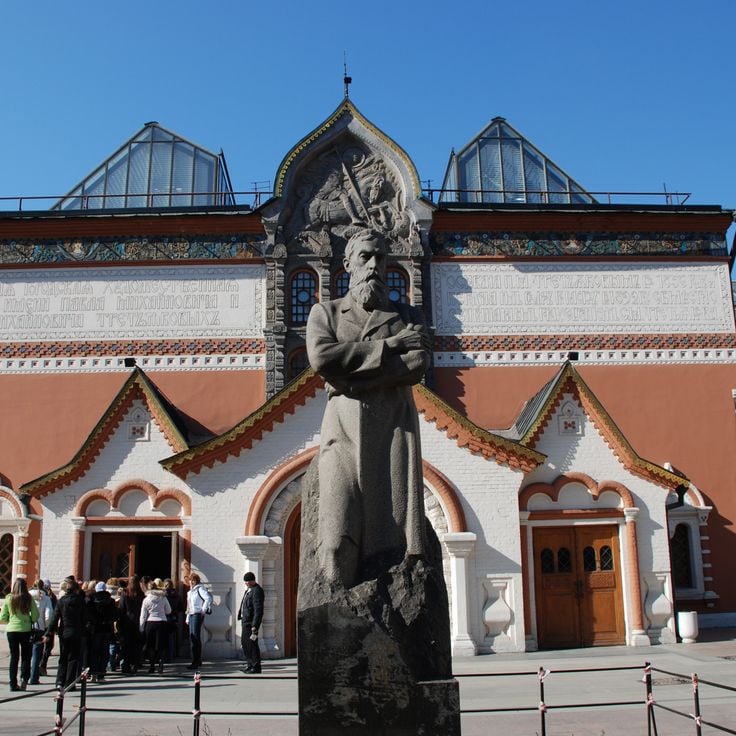
The Tretyakov Gallery is Moscow's main museum of Russian painting. Its rooms hold works from medieval icons to early 20th-century canvases. Walking through, you see how Russian artists portrayed saints, landscapes, and everyday life across the centuries. The collection traces a clear line through the history of Russian art, from religious imagery to realist and later modern painting.
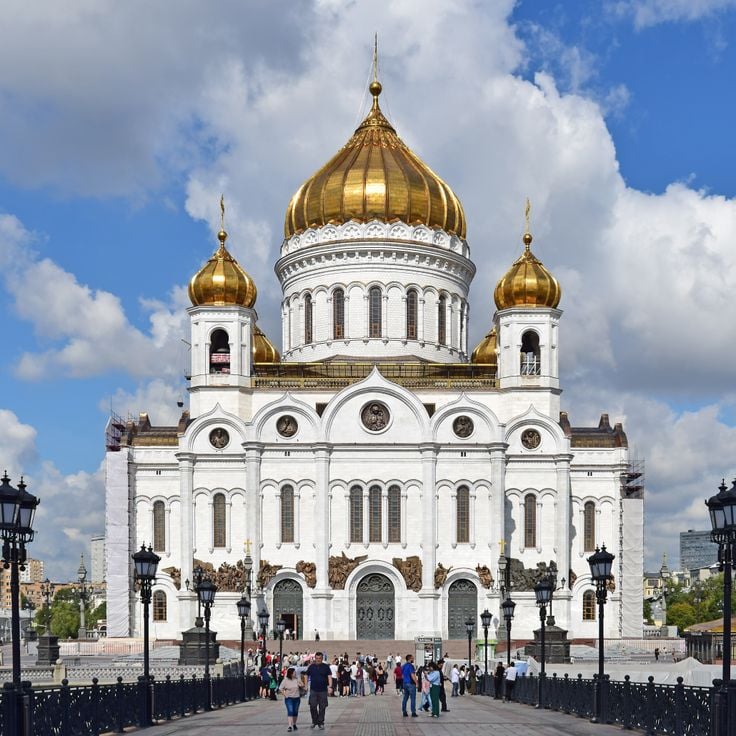
The Cathedral of Christ the Savior stands white and massive on the banks of the Moskva River. The current building was rebuilt in the 1990s after Stalin had the original demolished in 1931. Visible from many points across the city, it is one of the most recognized landmarks on the Moscow skyline.
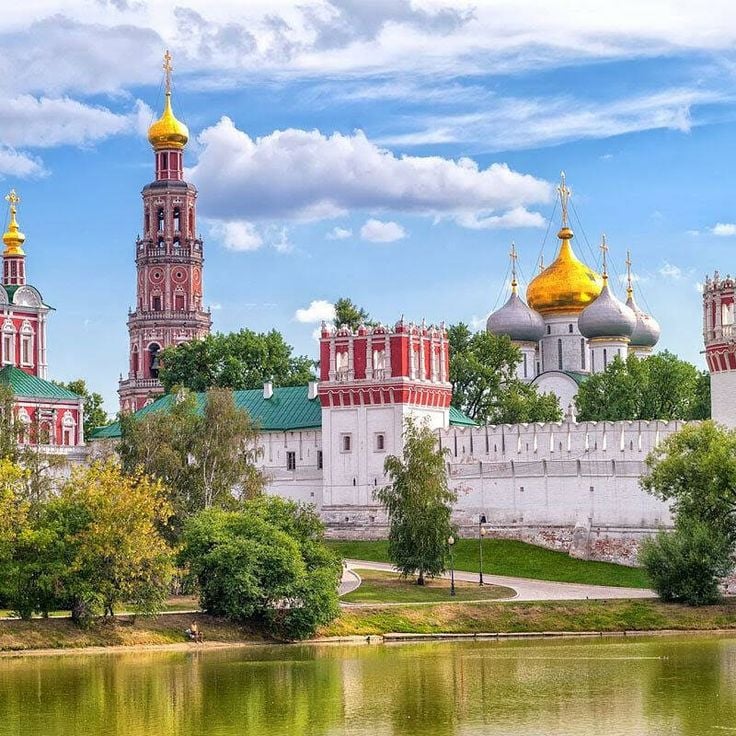
The Novodevichy Convent is a fortified religious complex on the edge of Moscow. Behind its walls stand several churches, a bell tower, and a cloister built over the centuries starting in the 16th century. The site is a UNESCO World Heritage Site and one of the few religious ensembles in Russia that has kept much of its original appearance. Walking through the grounds, you get a clear sense of how monastic life and political power were closely linked in old Russia.
Zaryadye Park sits right next to Red Square, on land where an old neighborhood once stood. The park was designed to reflect the different natural landscapes of Russia, from tundra to forest. A floating bridge extends out over the Moskva River, offering a clear view of the Kremlin walls and the river below. The spot draws both locals and visitors throughout the day, and the evenings here are particularly pleasant for a walk.
The Moscow Metro is more than a transit network. Its stations are lined with marble, mosaics, chandeliers, and sculptures that feel closer to a gallery than a subway stop. Stations like Mayakovskaya, Komsomolskaya, and Ploshchad Revolyutsii each have their own style, shaped during the Soviet era. Riding through this network gives a real sense of how public spaces were built and used in the USSR.
VDNKh is a large Soviet-era exhibition complex in northern Moscow. Its pavilions were built in styles ranging from neoclassical to Stalinist, each originally dedicated to a Soviet republic or an industrial sector. Between the buildings stand monumental fountains, including the Friendship of Nations fountain with its gilded figures. Today the site works as a public park, and locals of all ages come here to walk, skate, and spend time outdoors.
The Kolomenskoye estate sits on the bank of the Moskva River, a short distance south of central Moscow. It was once a summer residence of the tsars, and today it functions as a large open park that many Muscovites visit on weekends. At its center stands the Church of the Ascension, a white stone tower built in the 16th century with a tent-shaped roof that was unusual for Russian architecture at the time. The church is recognized by UNESCO and rises clearly above the surrounding trees and riverbank. Around it, the grounds include old orchards, wooden structures brought from different parts of Russia, and open grassy areas where people walk and rest.
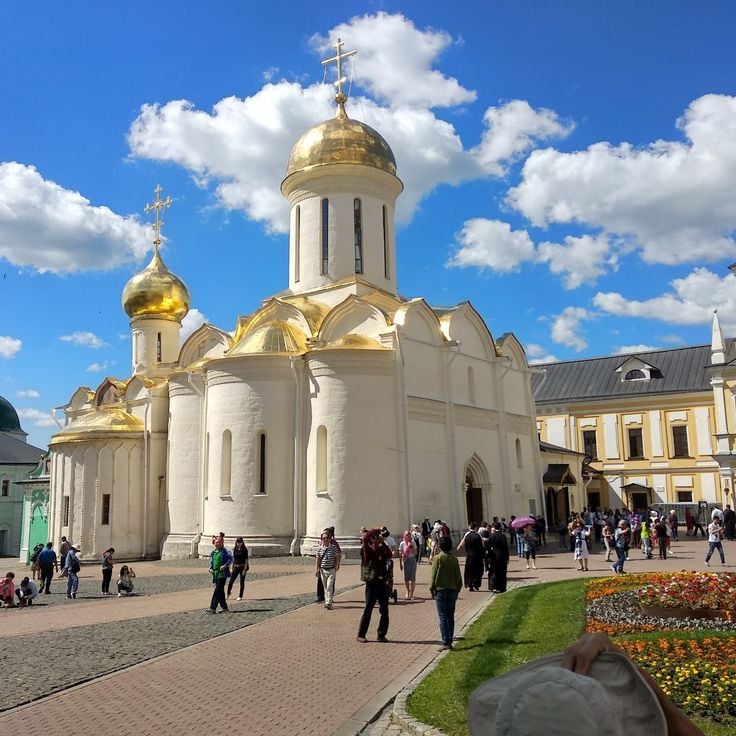
The Trinity-St. Sergius Lavra is one of the most important Orthodox monasteries in Russia. It stands in Sergiyev Posad, about 45 miles (70 kilometers) north of Moscow. Inside the walls, several churches from different centuries stand close together, including the white-and-blue Assumption Cathedral and the smaller Trinity Cathedral. Monks still live here today, and pilgrims come throughout the year. The complex is listed as a UNESCO World Heritage site.
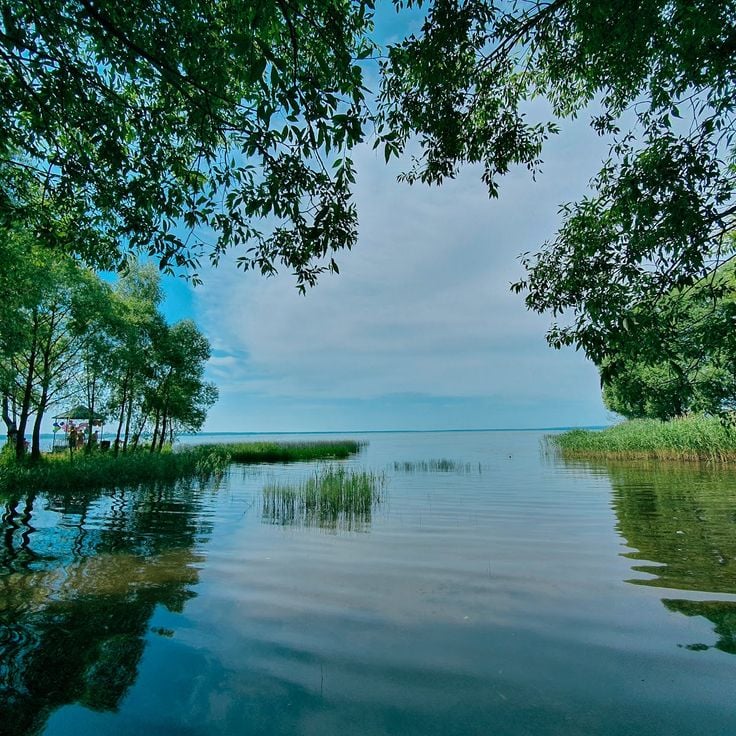
Lake Pleshcheyevo sits at the heart of Pereslavl-Zalessky and has shaped life in this old Russian town since the Middle Ages. Its shallow shores and open water draw walkers and fishermen throughout the year. In winter the lake freezes over, in summer its banks become a popular spot for families from the area. Peter the Great used the lake to train a small fleet, and a museum near the shore still tells that story today.
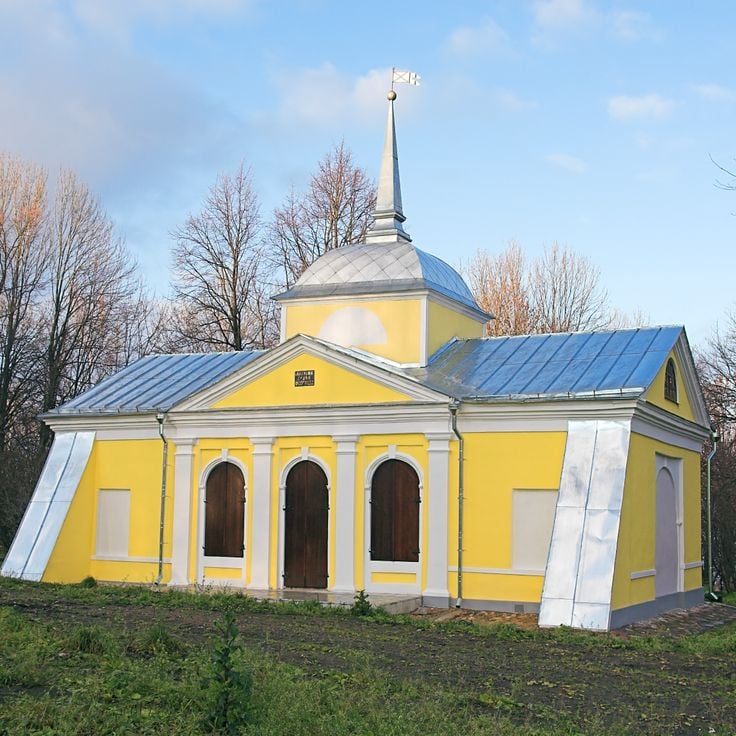
The Botik Museum in Pereslavl-Zalessky holds a small wooden boat tied to the early years of Peter the Great. As a young man, Peter is said to have sailed on Lake Pleshcheyevo to learn how ships move and behave on water. The boat, called Fortuna, is thought to be one of the last survivors of that early practice fleet. The museum sits on a low hill near the lake, and the setting gives a sense of how this remote spot shaped the ambitions of a future tsar.
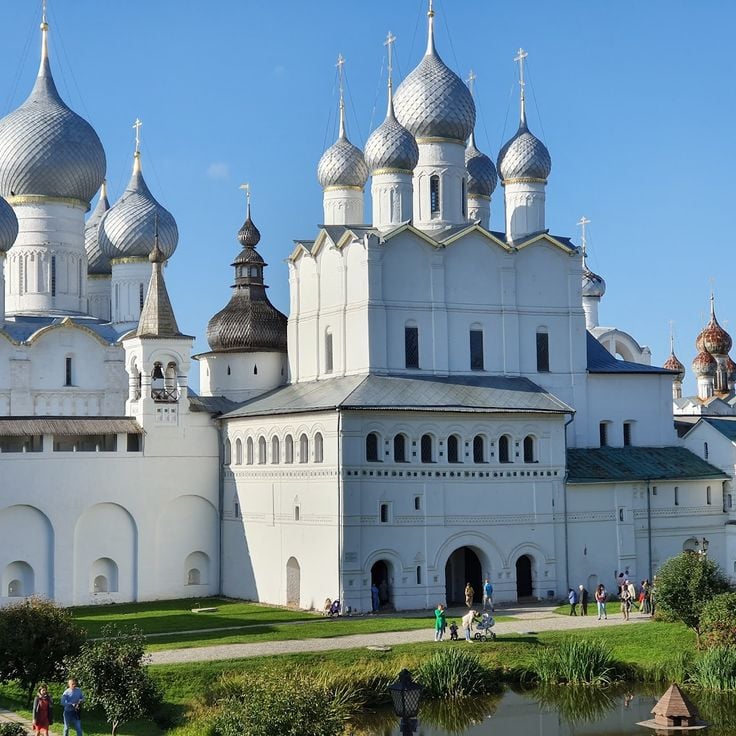
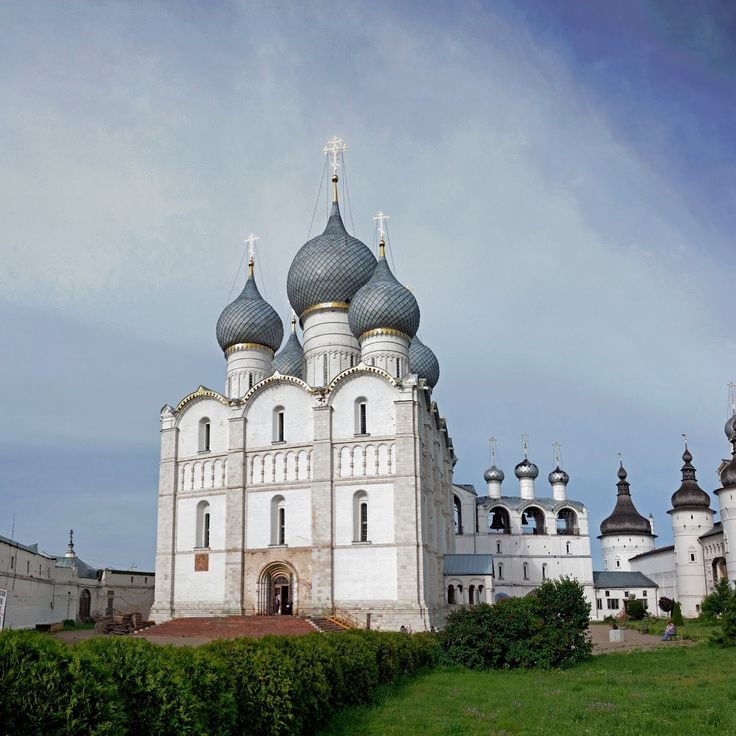
The Kremlin of Rostov Veliky is a fortified complex from the 17th century, built on the shore of Lake Nero. Its thick white walls and towers enclose several cathedrals and palaces that once belonged to the local Orthodox metropolitan. Walking inside feels like stepping into medieval Russia, with the golden domes rising above the stone courtyards. The complex is one of the best preserved along the Golden Ring and remains the heart of the old city.
The Dormition Cathedral is the oldest building inside the Rostov Kremlin. Its detached bell tower, built in the 17th century, is known across Russia for the sound of its bells, which were cast on site and can be heard from far away. The white walls and green domes of the cathedral reflect the style of early Russian church architecture. Inside, the space is simple and decorated with frescoes.
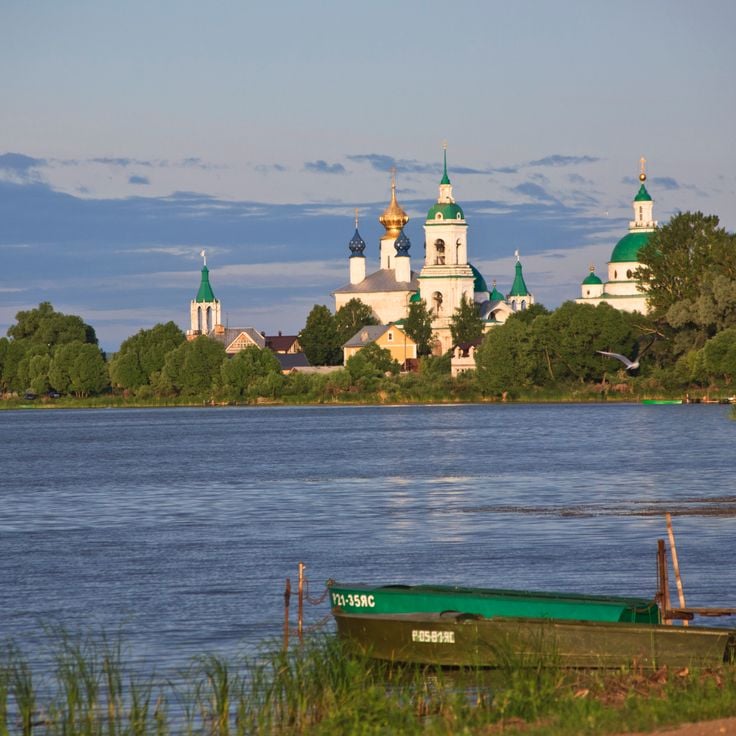
The Spasso-Yakovlevsky Monastery sits on the shore of Lake Nero, on the edge of Rostov Veliky. Behind its white walls stand several churches built between the 17th and 18th centuries, mixing early Russian Baroque with later classical styles. The monastery is still active today and is one of the clearest examples of religious architecture along the Golden Ring. Walking through its gate, you get a direct view of the lake and the church domes reflected in the water.
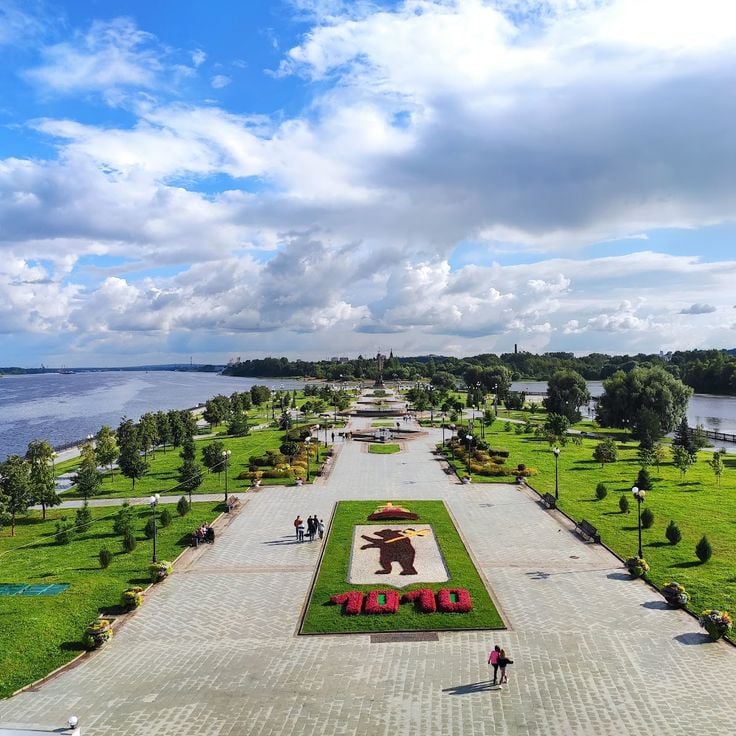
The historic center of Yaroslavl sits at the point where the Volga and Kotorosl rivers meet. As part of the Golden Ring, this city holds one of the densest collections of 17th-century Russian church architecture. Walking through the old streets, you see colorful onion domes, frescoed church facades, and merchant courtyards from the tsarist era. UNESCO recognized this cityscape as a whole because it shows what a Russian trading city looked like between the medieval and modern periods. The area is about 500 meters (1,600 ft) from the riverbanks at its widest.
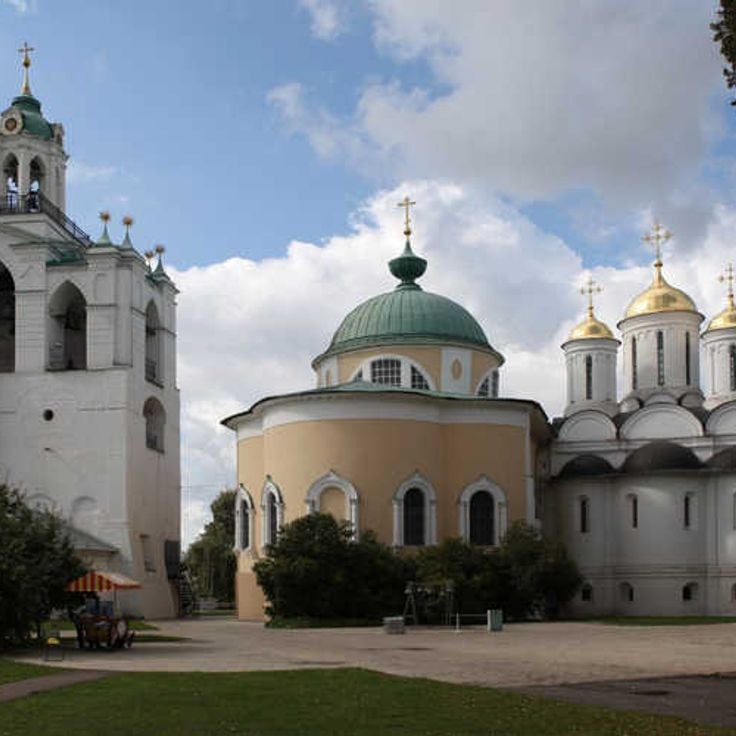
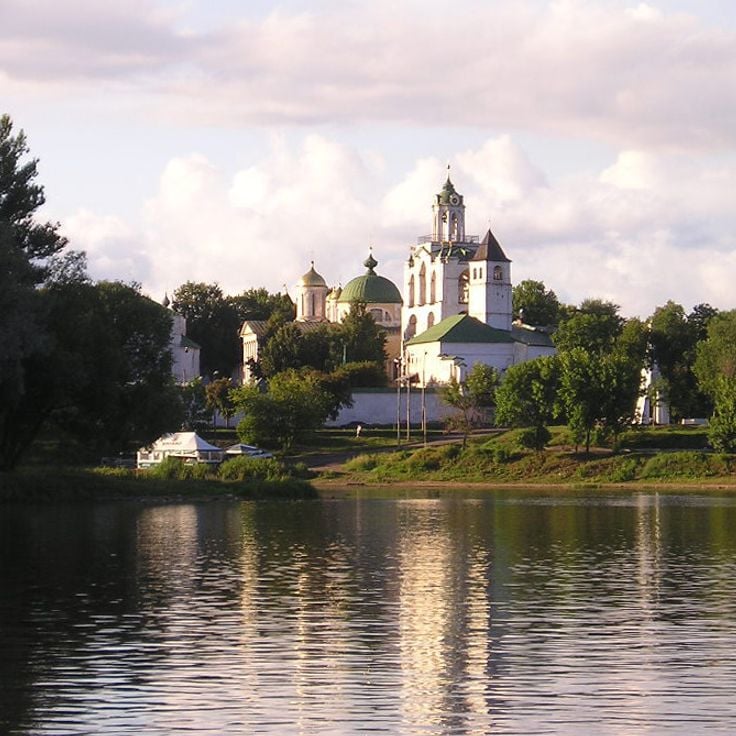
The Monastery of the Transfiguration of the Savior stands at the heart of Yaroslavl and is one of the oldest monasteries in Russia. Its walls, dating back to the 16th century, enclose several churches and a cloister that reflect the religious life of the city before the Romanov era. The monastery is considered the founding site of Yaroslavl and served for centuries as a spiritual and cultural center of the region.
The Strelka of Yaroslavl sits at the point where the Volga and the Kotorosl rivers meet. From this open space, you can see the old church towers of the city rising above the riverbanks. Locals come here to walk along the water, and the view stretches across both rivers at once. It is one of those spots that quickly shows you why Yaroslavl grew up around its waterways.
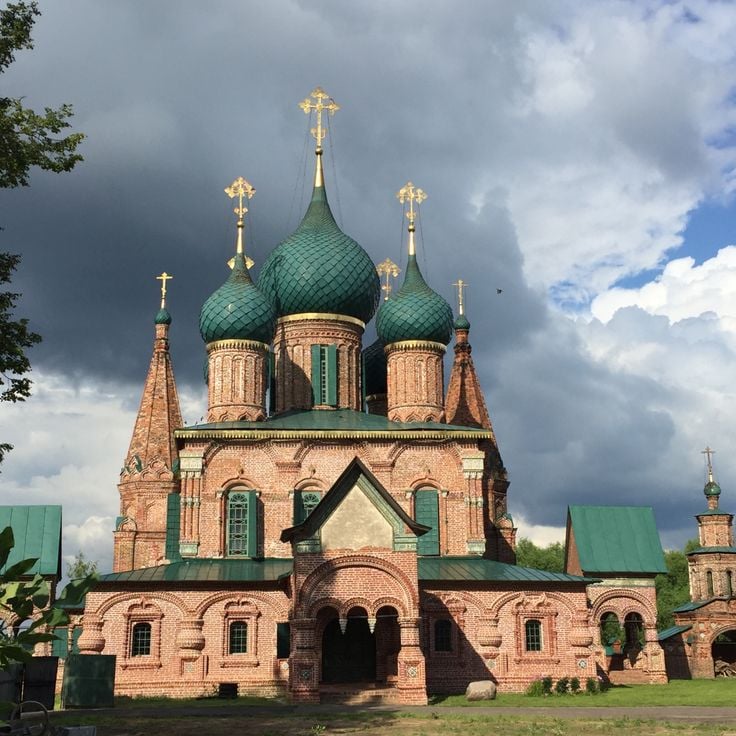
The Church of St. John the Baptist in Tolchkovo is a 17th-century church in the Tolchkovo district of Yaroslavl. Its five golden domes rise above the rooftops and its red brick walls are covered with detailed frescoes inside. The building shows what Russian religious architecture looked like during the peak of church construction in the Yaroslavl region.
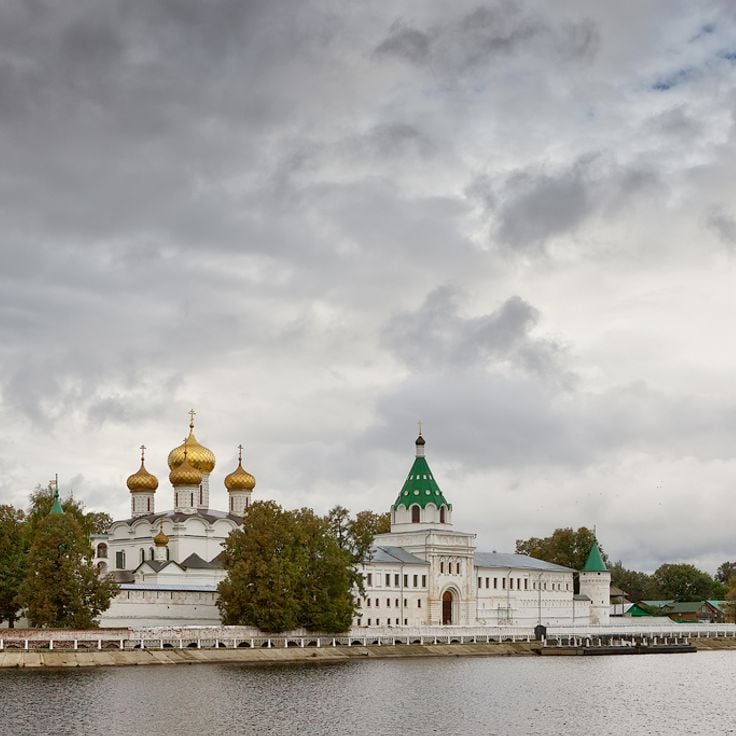
The Ipatiev Monastery sits at the edge of Kostroma, where two rivers meet. It is one of the oldest monasteries in Russia and holds a special place in the history of the Romanov dynasty, since it was here that Mikhail Romanov was proclaimed tsar in 1613. Behind its thick fortified walls stand several churches, including one covered in colorful frescoes from the 17th century. The place feels removed from the city, almost like a small world of its own.
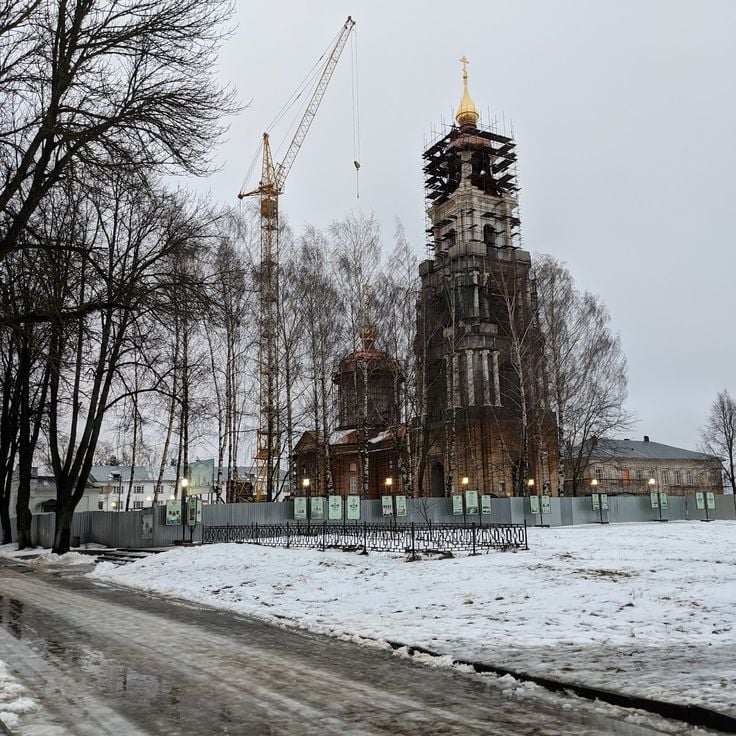
Susaninskaya Square is the heart of Kostroma. It is lined with classical buildings from the 18th and 19th centuries, arranged in a fan-shaped pattern around a central point. A tall pyramidal watchtower stands at its center, once used to spot fires across the city. Walking through the square gives a clear sense of how the city was planned and how daily life still flows through it today.
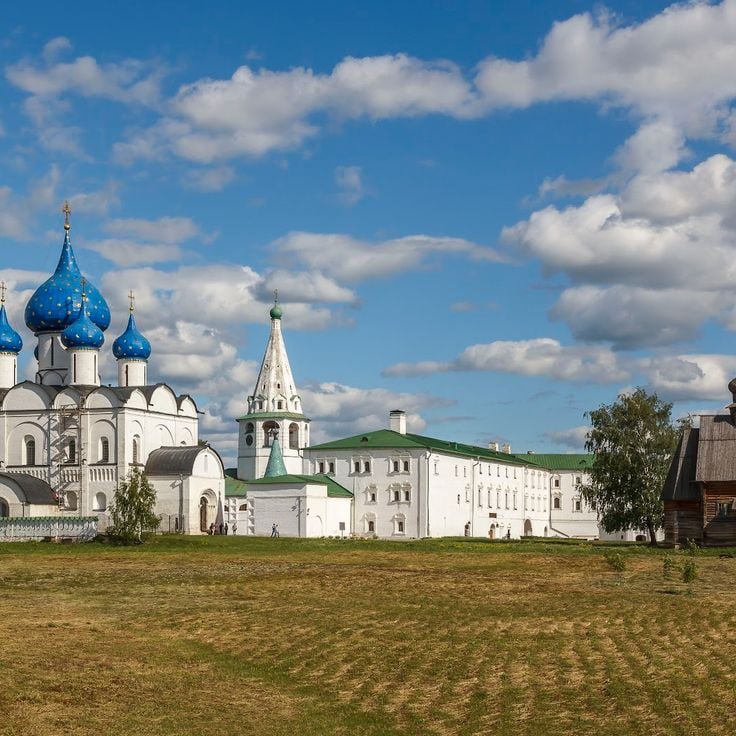
The Suzdal Kremlin is the oldest part of the city, a fortified center dating back to medieval times. Its earthen ramparts once supported wooden walls, and the Nativity Cathedral rises at its heart, topped with blue domes covered in golden stars. Several churches and a bishop's palace stand inside the grounds, with the palace now housing a museum. Walking through, the place feels largely unchanged over the centuries.
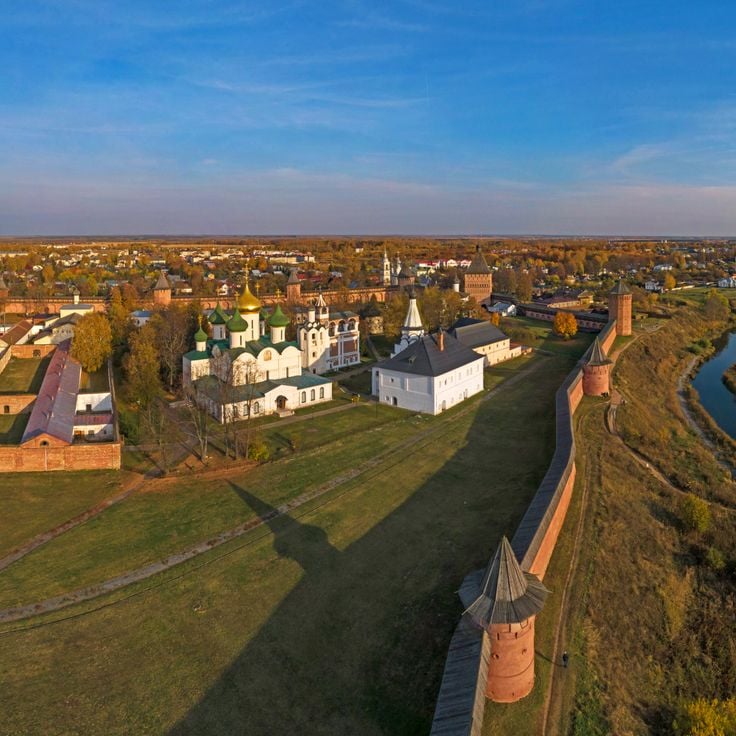
The Savior-Saint-Euthymius Monastery sits on the bank of the Kamenka River in Suzdal, enclosed by long white walls with towers that give it the look of a fortress. Founded in the 14th century, it is one of the largest monastery complexes in Russia. Inside the walls, you will find several churches, a bell tower, and old cloisters gathered around the Cathedral of the Transfiguration of the Savior, whose blue domes rise above the ramparts. The monastery is part of the UNESCO World Heritage Site of Suzdal and gives a clear sense of what monastic life looked like in medieval Russia.
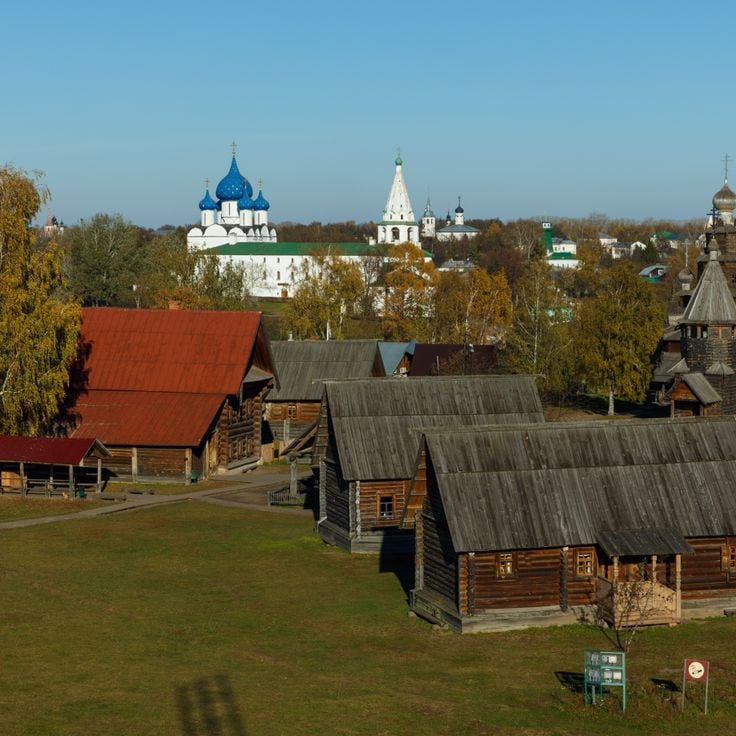
This open-air museum in Suzdal brings together wooden farmhouses, windmills, and churches gathered from villages across the region. Walking through the grounds gives a clear sense of what rural Russian life looked like over the centuries. The buildings stand in an open setting that fits naturally with the medieval skyline of the town around it.
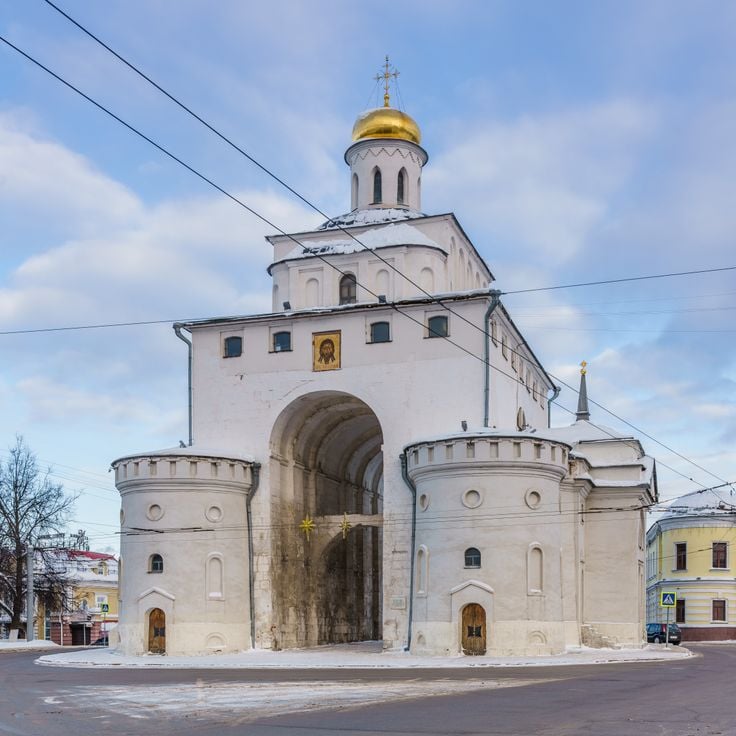
The Golden Gate in Vladimir is a 12th-century stone gateway that once marked the main western entrance to the city. Built under Prince Andrei Bogolyubsky, it served as both a military fortification and a ceremonial arch for the princes of the Vladimir principality. It is one of the few remaining structures from medieval Russia that still stands in its original location. Today, visitors can climb inside and see a small museum dedicated to the city's history.
The Cathedral of the Dormition in Vladimir is one of the oldest stone churches in Russia. Built in the 12th century, it served for a long time as the main cathedral of the country. Inside, you can see frescoes attributed to the renowned icon painter Andrei Rublev. Its white limestone walls and golden dome remain a defining feature of Vladimir's skyline.
The Cathedral of Saint Demetrius in Vladimir was built in the 12th century and stands out for the carvings that cover its white limestone walls. Hundreds of relief sculptures show saints, mythical animals, and plant motifs, all carved directly into the stone. Walking around the building, you notice how the decoration covers nearly every surface. The cathedral sits in the center of Vladimir and is part of the UNESCO World Heritage site that includes several churches of the region.
The Church of the Intercession of the Virgin on the Nerl stands alone in an open meadow on the bank of the Nerl River, near Bogolyubovo. Built in the 12th century, it is one of the oldest stone churches still standing in Russia. The white limestone walls catch the light differently through the seasons, and in spring, when the river floods the surrounding fields, the church appears to rise from the water. Inside, the space is small and spare, with almost no decoration.
Saint Basil's Cathedral stands at one end of Red Square in Moscow and is one of the most recognized buildings in Russia. Its nine towers are each topped with a differently shaped and colored onion dome. The cathedral was completed in the 16th century and was built to mark military victories. Visitors can go inside and explore a series of small chapels connected by narrow passageways.
Red Square is the historical center of Moscow. It sits just beside the Kremlin and is bordered by buildings that have shaped Russian history for centuries. On one side stands Saint Basil's Cathedral with its nine colorful onion domes, on another the long facade of the GUM department store. The square has hosted parades, markets, and public gatherings, and walking across its cobblestones gives a strong sense of how much of Russia's story has played out in this one place.
The Moscow Kremlin is the historical core of the Russian capital. Behind its red brick walls stand cathedrals, palaces, and government buildings side by side. You can see gilded domes, cobbled courtyards, and structures from many different periods. For centuries, it was home to the tsar and the patriarch, and today it remains the seat of the Russian president.
The Cathedral of the Dormition inside the Kremlin is where the Russian tsars were crowned for centuries. Built in the 15th century, it is one of the oldest churches in Moscow. Its white walls and golden domes stand at the heart of the Kremlin complex. Inside, you can see old icons and frescoes that cover almost every surface, giving a sense of how central this place was to Russian religious and political life.
The Armory Palace sits inside the Moscow Kremlin and holds the imperial collections of the Russian tsars. Visitors can see crowns, gilded carriages, weapons and precious objects gathered over centuries of royal life. The rooms give a clear sense of how Russian rulers displayed their wealth and power.
The Tretyakov Gallery is Moscow's main museum of Russian painting. Its rooms hold works from medieval icons to early 20th-century canvases. Walking through, you see how Russian artists portrayed saints, landscapes, and everyday life across the centuries. The collection traces a clear line through the history of Russian art, from religious imagery to realist and later modern painting.
The Cathedral of Christ the Savior stands white and massive on the banks of the Moskva River. The current building was rebuilt in the 1990s after Stalin had the original demolished in 1931. Visible from many points across the city, it is one of the most recognized landmarks on the Moscow skyline.
The Novodevichy Convent is a fortified religious complex on the edge of Moscow. Behind its walls stand several churches, a bell tower, and a cloister built over the centuries starting in the 16th century. The site is a UNESCO World Heritage Site and one of the few religious ensembles in Russia that has kept much of its original appearance. Walking through the grounds, you get a clear sense of how monastic life and political power were closely linked in old Russia.
Zaryadye Park sits right next to Red Square, on land where an old neighborhood once stood. The park was designed to reflect the different natural landscapes of Russia, from tundra to forest. A floating bridge extends out over the Moskva River, offering a clear view of the Kremlin walls and the river below. The spot draws both locals and visitors throughout the day, and the evenings here are particularly pleasant for a walk.
The Moscow Metro is more than a transit network. Its stations are lined with marble, mosaics, chandeliers, and sculptures that feel closer to a gallery than a subway stop. Stations like Mayakovskaya, Komsomolskaya, and Ploshchad Revolyutsii each have their own style, shaped during the Soviet era. Riding through this network gives a real sense of how public spaces were built and used in the USSR.
VDNKh is a large Soviet-era exhibition complex in northern Moscow. Its pavilions were built in styles ranging from neoclassical to Stalinist, each originally dedicated to a Soviet republic or an industrial sector. Between the buildings stand monumental fountains, including the Friendship of Nations fountain with its gilded figures. Today the site works as a public park, and locals of all ages come here to walk, skate, and spend time outdoors.
The Kolomenskoye estate sits on the bank of the Moskva River, a short distance south of central Moscow. It was once a summer residence of the tsars, and today it functions as a large open park that many Muscovites visit on weekends. At its center stands the Church of the Ascension, a white stone tower built in the 16th century with a tent-shaped roof that was unusual for Russian architecture at the time. The church is recognized by UNESCO and rises clearly above the surrounding trees and riverbank. Around it, the grounds include old orchards, wooden structures brought from different parts of Russia, and open grassy areas where people walk and rest.
The Trinity-St. Sergius Lavra is one of the most important Orthodox monasteries in Russia. It stands in Sergiyev Posad, about 45 miles (70 kilometers) north of Moscow. Inside the walls, several churches from different centuries stand close together, including the white-and-blue Assumption Cathedral and the smaller Trinity Cathedral. Monks still live here today, and pilgrims come throughout the year. The complex is listed as a UNESCO World Heritage site.
Lake Pleshcheyevo sits at the heart of Pereslavl-Zalessky and has shaped life in this old Russian town since the Middle Ages. Its shallow shores and open water draw walkers and fishermen throughout the year. In winter the lake freezes over, in summer its banks become a popular spot for families from the area. Peter the Great used the lake to train a small fleet, and a museum near the shore still tells that story today.
The Botik Museum in Pereslavl-Zalessky holds a small wooden boat tied to the early years of Peter the Great. As a young man, Peter is said to have sailed on Lake Pleshcheyevo to learn how ships move and behave on water. The boat, called Fortuna, is thought to be one of the last survivors of that early practice fleet. The museum sits on a low hill near the lake, and the setting gives a sense of how this remote spot shaped the ambitions of a future tsar.
The Kremlin of Rostov Veliky is a fortified complex from the 17th century, built on the shore of Lake Nero. Its thick white walls and towers enclose several cathedrals and palaces that once belonged to the local Orthodox metropolitan. Walking inside feels like stepping into medieval Russia, with the golden domes rising above the stone courtyards. The complex is one of the best preserved along the Golden Ring and remains the heart of the old city.
The Dormition Cathedral is the oldest building inside the Rostov Kremlin. Its detached bell tower, built in the 17th century, is known across Russia for the sound of its bells, which were cast on site and can be heard from far away. The white walls and green domes of the cathedral reflect the style of early Russian church architecture. Inside, the space is simple and decorated with frescoes.
The Spasso-Yakovlevsky Monastery sits on the shore of Lake Nero, on the edge of Rostov Veliky. Behind its white walls stand several churches built between the 17th and 18th centuries, mixing early Russian Baroque with later classical styles. The monastery is still active today and is one of the clearest examples of religious architecture along the Golden Ring. Walking through its gate, you get a direct view of the lake and the church domes reflected in the water.
The historic center of Yaroslavl sits at the point where the Volga and Kotorosl rivers meet. As part of the Golden Ring, this city holds one of the densest collections of 17th-century Russian church architecture. Walking through the old streets, you see colorful onion domes, frescoed church facades, and merchant courtyards from the tsarist era. UNESCO recognized this cityscape as a whole because it shows what a Russian trading city looked like between the medieval and modern periods. The area is about 500 meters (1,600 ft) from the riverbanks at its widest.
The Monastery of the Transfiguration of the Savior stands at the heart of Yaroslavl and is one of the oldest monasteries in Russia. Its walls, dating back to the 16th century, enclose several churches and a cloister that reflect the religious life of the city before the Romanov era. The monastery is considered the founding site of Yaroslavl and served for centuries as a spiritual and cultural center of the region.
The Strelka of Yaroslavl sits at the point where the Volga and the Kotorosl rivers meet. From this open space, you can see the old church towers of the city rising above the riverbanks. Locals come here to walk along the water, and the view stretches across both rivers at once. It is one of those spots that quickly shows you why Yaroslavl grew up around its waterways.
The Church of St. John the Baptist in Tolchkovo is a 17th-century church in the Tolchkovo district of Yaroslavl. Its five golden domes rise above the rooftops and its red brick walls are covered with detailed frescoes inside. The building shows what Russian religious architecture looked like during the peak of church construction in the Yaroslavl region.
The Ipatiev Monastery sits at the edge of Kostroma, where two rivers meet. It is one of the oldest monasteries in Russia and holds a special place in the history of the Romanov dynasty, since it was here that Mikhail Romanov was proclaimed tsar in 1613. Behind its thick fortified walls stand several churches, including one covered in colorful frescoes from the 17th century. The place feels removed from the city, almost like a small world of its own.
Susaninskaya Square is the heart of Kostroma. It is lined with classical buildings from the 18th and 19th centuries, arranged in a fan-shaped pattern around a central point. A tall pyramidal watchtower stands at its center, once used to spot fires across the city. Walking through the square gives a clear sense of how the city was planned and how daily life still flows through it today.
The Suzdal Kremlin is the oldest part of the city, a fortified center dating back to medieval times. Its earthen ramparts once supported wooden walls, and the Nativity Cathedral rises at its heart, topped with blue domes covered in golden stars. Several churches and a bishop's palace stand inside the grounds, with the palace now housing a museum. Walking through, the place feels largely unchanged over the centuries.
The Savior-Saint-Euthymius Monastery sits on the bank of the Kamenka River in Suzdal, enclosed by long white walls with towers that give it the look of a fortress. Founded in the 14th century, it is one of the largest monastery complexes in Russia. Inside the walls, you will find several churches, a bell tower, and old cloisters gathered around the Cathedral of the Transfiguration of the Savior, whose blue domes rise above the ramparts. The monastery is part of the UNESCO World Heritage Site of Suzdal and gives a clear sense of what monastic life looked like in medieval Russia.
This open-air museum in Suzdal brings together wooden farmhouses, windmills, and churches gathered from villages across the region. Walking through the grounds gives a clear sense of what rural Russian life looked like over the centuries. The buildings stand in an open setting that fits naturally with the medieval skyline of the town around it.
The Golden Gate in Vladimir is a 12th-century stone gateway that once marked the main western entrance to the city. Built under Prince Andrei Bogolyubsky, it served as both a military fortification and a ceremonial arch for the princes of the Vladimir principality. It is one of the few remaining structures from medieval Russia that still stands in its original location. Today, visitors can climb inside and see a small museum dedicated to the city's history.
The Cathedral of the Dormition in Vladimir is one of the oldest stone churches in Russia. Built in the 12th century, it served for a long time as the main cathedral of the country. Inside, you can see frescoes attributed to the renowned icon painter Andrei Rublev. Its white limestone walls and golden dome remain a defining feature of Vladimir's skyline.
The Cathedral of Saint Demetrius in Vladimir was built in the 12th century and stands out for the carvings that cover its white limestone walls. Hundreds of relief sculptures show saints, mythical animals, and plant motifs, all carved directly into the stone. Walking around the building, you notice how the decoration covers nearly every surface. The cathedral sits in the center of Vladimir and is part of the UNESCO World Heritage site that includes several churches of the region.
The Church of the Intercession of the Virgin on the Nerl stands alone in an open meadow on the bank of the Nerl River, near Bogolyubovo. Built in the 12th century, it is one of the oldest stone churches still standing in Russia. The white limestone walls catch the light differently through the seasons, and in spring, when the river floods the surrounding fields, the church appears to rise from the water. Inside, the space is small and spare, with almost no decoration.
Saint Basil's Cathedral stands at one end of Red Square in Moscow and is one of the most recognized buildings in Russia. Its nine towers are each topped with a differently shaped and colored onion dome. The cathedral was completed in the 16th century and was built to mark military victories. Visitors can go inside and explore a series of small chapels connected by narrow passageways.
Red Square is the historical center of Moscow. It sits just beside the Kremlin and is bordered by buildings that have shaped Russian history for centuries. On one side stands Saint Basil's Cathedral with its nine colorful onion domes, on another the long facade of the GUM department store. The square has hosted parades, markets, and public gatherings, and walking across its cobblestones gives a strong sense of how much of Russia's story has played out in this one place.
The Moscow Kremlin is the historical core of the Russian capital. Behind its red brick walls stand cathedrals, palaces, and government buildings side by side. You can see gilded domes, cobbled courtyards, and structures from many different periods. For centuries, it was home to the tsar and the patriarch, and today it remains the seat of the Russian president.
The Cathedral of the Dormition inside the Kremlin is where the Russian tsars were crowned for centuries. Built in the 15th century, it is one of the oldest churches in Moscow. Its white walls and golden domes stand at the heart of the Kremlin complex. Inside, you can see old icons and frescoes that cover almost every surface, giving a sense of how central this place was to Russian religious and political life.
The Armory Palace sits inside the Moscow Kremlin and holds the imperial collections of the Russian tsars. Visitors can see crowns, gilded carriages, weapons and precious objects gathered over centuries of royal life. The rooms give a clear sense of how Russian rulers displayed their wealth and power.
The Tretyakov Gallery is Moscow's main museum of Russian painting. Its rooms hold works from medieval icons to early 20th-century canvases. Walking through, you see how Russian artists portrayed saints, landscapes, and everyday life across the centuries. The collection traces a clear line through the history of Russian art, from religious imagery to realist and later modern painting.
The Cathedral of Christ the Savior stands white and massive on the banks of the Moskva River. The current building was rebuilt in the 1990s after Stalin had the original demolished in 1931. Visible from many points across the city, it is one of the most recognized landmarks on the Moscow skyline.
The Novodevichy Convent is a fortified religious complex on the edge of Moscow. Behind its walls stand several churches, a bell tower, and a cloister built over the centuries starting in the 16th century. The site is a UNESCO World Heritage Site and one of the few religious ensembles in Russia that has kept much of its original appearance. Walking through the grounds, you get a clear sense of how monastic life and political power were closely linked in old Russia.
Zaryadye Park sits right next to Red Square, on land where an old neighborhood once stood. The park was designed to reflect the different natural landscapes of Russia, from tundra to forest. A floating bridge extends out over the Moskva River, offering a clear view of the Kremlin walls and the river below. The spot draws both locals and visitors throughout the day, and the evenings here are particularly pleasant for a walk.
The Moscow Metro is more than a transit network. Its stations are lined with marble, mosaics, chandeliers, and sculptures that feel closer to a gallery than a subway stop. Stations like Mayakovskaya, Komsomolskaya, and Ploshchad Revolyutsii each have their own style, shaped during the Soviet era. Riding through this network gives a real sense of how public spaces were built and used in the USSR.
VDNKh is a large Soviet-era exhibition complex in northern Moscow. Its pavilions were built in styles ranging from neoclassical to Stalinist, each originally dedicated to a Soviet republic or an industrial sector. Between the buildings stand monumental fountains, including the Friendship of Nations fountain with its gilded figures. Today the site works as a public park, and locals of all ages come here to walk, skate, and spend time outdoors.
The Kolomenskoye estate sits on the bank of the Moskva River, a short distance south of central Moscow. It was once a summer residence of the tsars, and today it functions as a large open park that many Muscovites visit on weekends. At its center stands the Church of the Ascension, a white stone tower built in the 16th century with a tent-shaped roof that was unusual for Russian architecture at the time. The church is recognized by UNESCO and rises clearly above the surrounding trees and riverbank. Around it, the grounds include old orchards, wooden structures brought from different parts of Russia, and open grassy areas where people walk and rest.
The Trinity-St. Sergius Lavra is one of the most important Orthodox monasteries in Russia. It stands in Sergiyev Posad, about 45 miles (70 kilometers) north of Moscow. Inside the walls, several churches from different centuries stand close together, including the white-and-blue Assumption Cathedral and the smaller Trinity Cathedral. Monks still live here today, and pilgrims come throughout the year. The complex is listed as a UNESCO World Heritage site.
Lake Pleshcheyevo sits at the heart of Pereslavl-Zalessky and has shaped life in this old Russian town since the Middle Ages. Its shallow shores and open water draw walkers and fishermen throughout the year. In winter the lake freezes over, in summer its banks become a popular spot for families from the area. Peter the Great used the lake to train a small fleet, and a museum near the shore still tells that story today.
The Botik Museum in Pereslavl-Zalessky holds a small wooden boat tied to the early years of Peter the Great. As a young man, Peter is said to have sailed on Lake Pleshcheyevo to learn how ships move and behave on water. The boat, called Fortuna, is thought to be one of the last survivors of that early practice fleet. The museum sits on a low hill near the lake, and the setting gives a sense of how this remote spot shaped the ambitions of a future tsar.
The Kremlin of Rostov Veliky is a fortified complex from the 17th century, built on the shore of Lake Nero. Its thick white walls and towers enclose several cathedrals and palaces that once belonged to the local Orthodox metropolitan. Walking inside feels like stepping into medieval Russia, with the golden domes rising above the stone courtyards. The complex is one of the best preserved along the Golden Ring and remains the heart of the old city.
The Dormition Cathedral is the oldest building inside the Rostov Kremlin. Its detached bell tower, built in the 17th century, is known across Russia for the sound of its bells, which were cast on site and can be heard from far away. The white walls and green domes of the cathedral reflect the style of early Russian church architecture. Inside, the space is simple and decorated with frescoes.
The Spasso-Yakovlevsky Monastery sits on the shore of Lake Nero, on the edge of Rostov Veliky. Behind its white walls stand several churches built between the 17th and 18th centuries, mixing early Russian Baroque with later classical styles. The monastery is still active today and is one of the clearest examples of religious architecture along the Golden Ring. Walking through its gate, you get a direct view of the lake and the church domes reflected in the water.
The historic center of Yaroslavl sits at the point where the Volga and Kotorosl rivers meet. As part of the Golden Ring, this city holds one of the densest collections of 17th-century Russian church architecture. Walking through the old streets, you see colorful onion domes, frescoed church facades, and merchant courtyards from the tsarist era. UNESCO recognized this cityscape as a whole because it shows what a Russian trading city looked like between the medieval and modern periods. The area is about 500 meters (1,600 ft) from the riverbanks at its widest.
The Monastery of the Transfiguration of the Savior stands at the heart of Yaroslavl and is one of the oldest monasteries in Russia. Its walls, dating back to the 16th century, enclose several churches and a cloister that reflect the religious life of the city before the Romanov era. The monastery is considered the founding site of Yaroslavl and served for centuries as a spiritual and cultural center of the region.
The Strelka of Yaroslavl sits at the point where the Volga and the Kotorosl rivers meet. From this open space, you can see the old church towers of the city rising above the riverbanks. Locals come here to walk along the water, and the view stretches across both rivers at once. It is one of those spots that quickly shows you why Yaroslavl grew up around its waterways.
The Church of St. John the Baptist in Tolchkovo is a 17th-century church in the Tolchkovo district of Yaroslavl. Its five golden domes rise above the rooftops and its red brick walls are covered with detailed frescoes inside. The building shows what Russian religious architecture looked like during the peak of church construction in the Yaroslavl region.
The Ipatiev Monastery sits at the edge of Kostroma, where two rivers meet. It is one of the oldest monasteries in Russia and holds a special place in the history of the Romanov dynasty, since it was here that Mikhail Romanov was proclaimed tsar in 1613. Behind its thick fortified walls stand several churches, including one covered in colorful frescoes from the 17th century. The place feels removed from the city, almost like a small world of its own.
Susaninskaya Square is the heart of Kostroma. It is lined with classical buildings from the 18th and 19th centuries, arranged in a fan-shaped pattern around a central point. A tall pyramidal watchtower stands at its center, once used to spot fires across the city. Walking through the square gives a clear sense of how the city was planned and how daily life still flows through it today.
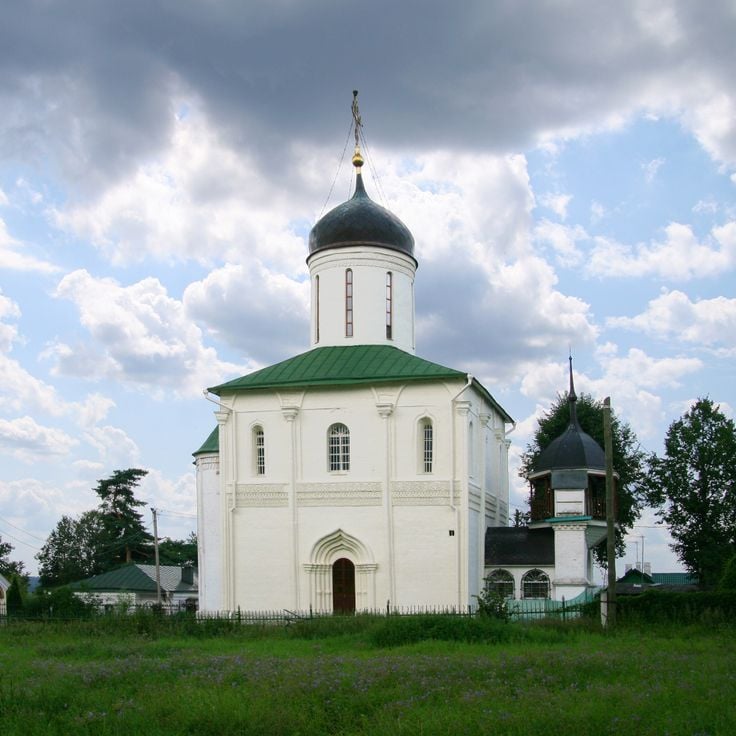
The Suzdal Kremlin is the oldest part of the city, a fortified center dating back to medieval times. Its earthen ramparts once supported wooden walls, and the Nativity Cathedral rises at its heart, topped with blue domes covered in golden stars. Several churches and a bishop's palace stand inside the grounds, with the palace now housing a museum. Walking through, the place feels largely unchanged over the centuries.
The Savior-Saint-Euthymius Monastery sits on the bank of the Kamenka River in Suzdal, enclosed by long white walls with towers that give it the look of a fortress. Founded in the 14th century, it is one of the largest monastery complexes in Russia. Inside the walls, you will find several churches, a bell tower, and old cloisters gathered around the Cathedral of the Transfiguration of the Savior, whose blue domes rise above the ramparts. The monastery is part of the UNESCO World Heritage Site of Suzdal and gives a clear sense of what monastic life looked like in medieval Russia.
This open-air museum in Suzdal brings together wooden farmhouses, windmills, and churches gathered from villages across the region. Walking through the grounds gives a clear sense of what rural Russian life looked like over the centuries. The buildings stand in an open setting that fits naturally with the medieval skyline of the town around it.
The Golden Gate in Vladimir is a 12th-century stone gateway that once marked the main western entrance to the city. Built under Prince Andrei Bogolyubsky, it served as both a military fortification and a ceremonial arch for the princes of the Vladimir principality. It is one of the few remaining structures from medieval Russia that still stands in its original location. Today, visitors can climb inside and see a small museum dedicated to the city's history.
The Cathedral of the Dormition in Vladimir is one of the oldest stone churches in Russia. Built in the 12th century, it served for a long time as the main cathedral of the country. Inside, you can see frescoes attributed to the renowned icon painter Andrei Rublev. Its white limestone walls and golden dome remain a defining feature of Vladimir's skyline.
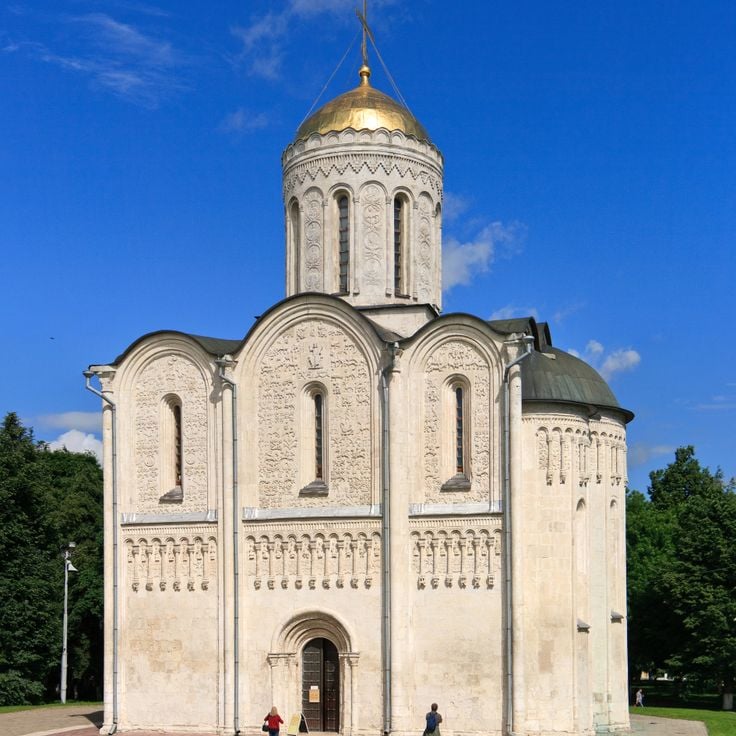
The Cathedral of Saint Demetrius in Vladimir was built in the 12th century and stands out for the carvings that cover its white limestone walls. Hundreds of relief sculptures show saints, mythical animals, and plant motifs, all carved directly into the stone. Walking around the building, you notice how the decoration covers nearly every surface. The cathedral sits in the center of Vladimir and is part of the UNESCO World Heritage site that includes several churches of the region.
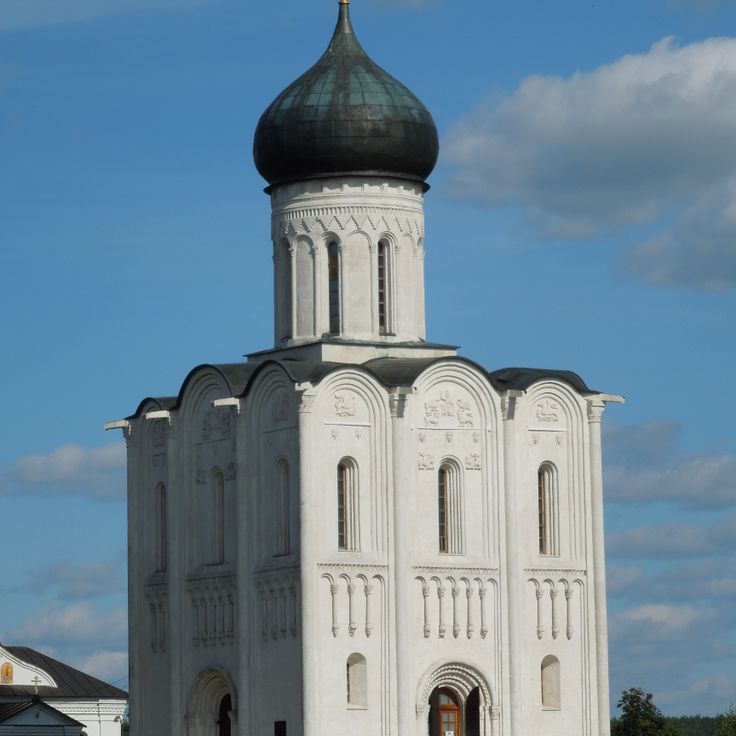
The Church of the Intercession of the Virgin on the Nerl stands alone in an open meadow on the bank of the Nerl River, near Bogolyubovo. Built in the 12th century, it is one of the oldest stone churches still standing in Russia. The white limestone walls catch the light differently through the seasons, and in spring, when the river floods the surrounding fields, the church appears to rise from the water. Inside, the space is small and spare, with almost no decoration.
Saint Basil's Cathedral stands at one end of Red Square in Moscow and is one of the most recognized buildings in Russia. Its nine towers are each topped with a differently shaped and colored onion dome. The cathedral was completed in the 16th century and was built to mark military victories. Visitors can go inside and explore a series of small chapels connected by narrow passageways.
Winter transforms these landscapes in dramatic ways, but roads become difficult to access. If you travel in the cold season, prepare for extreme conditions and book your transport well in advance. Spring and autumn offer a better balance between comfort and the beauty of the setting. Avoid the tourist summer if you are looking for a quieter experience.