Spaso-Yakovlevsky Monastery, Orthodox monastery at Lake Nero, Rostov, Russia
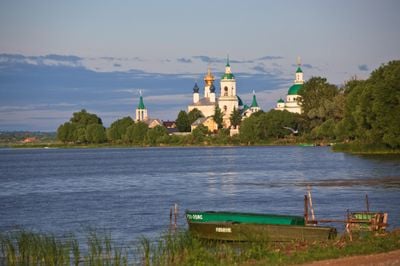
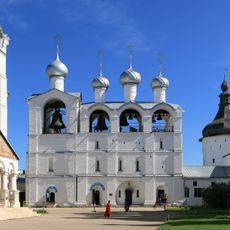
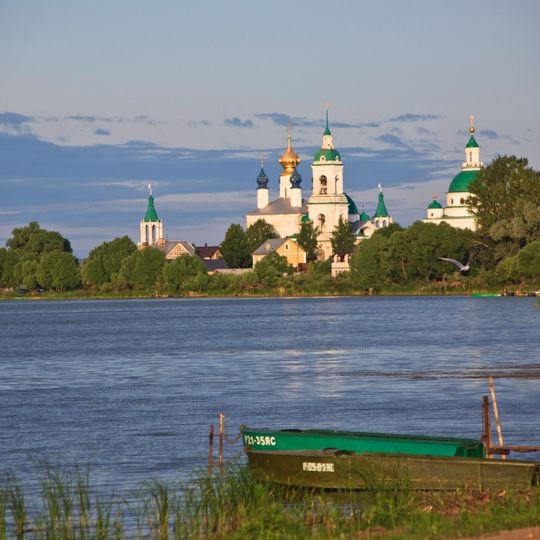
Spaso-Yakovlevsky Monastery stands on the shore of Lake Nero in Rostov. Its white buildings have green roofs, with a gold onion dome and a smaller gold dome on the main church, a green-domed bell tower, and a separate tower with a tall green spire. The Cathedral of the Conception of St Anna, built in 1686, is the oldest surviving structure and was painted by Yaroslavl masters in 1689.
Saint Jacob of Rostov founded the monastery in 1389 after being expelled from the city for sparing a condemned woman; he built a wooden Church of the Conception by a spring south of Rostov. All buildings remained wooden until 1686, when the five-domed Cathedral of the Conception of St Anna was erected and painted by Yaroslavl masters in 1689. In 1764 Catherine II placed the monastery under direct Holy Synod rule, and the abolished Spaso-Pesotsky Monastery's 17th-century Transfiguration Cathedral was assigned to it.
The monastery holds relics of Saint Dimitri of Rostov displayed in silver casings within its sacred spaces. Visitors can observe religious artworks created using traditional enamel painting methods throughout the churches.
Visitors can explore the grounds on foot and enter multiple buildings, including both main cathedrals and residential quarters. The pathways are generally walkable, and the site is easily visible from the lake shore, with walls and towers clearly marking the perimeter.
The monastery kept a handwritten ledger in which pilgrims recorded healings at the tomb of St Dmitry of Rostov; the book covers 1753 to 1764 and describes 288 cures, and is now held in the Rostov museum archive. The silver shrine made for his relics in 1758 from Kolyvan-mine silver carries an epitaph composed by Mikhail Lomonosov.
The community of curious travelers
AroundUs brings together thousands of curated places, local tips, and hidden gems, enriched daily by 93,144 contributors worldwide.