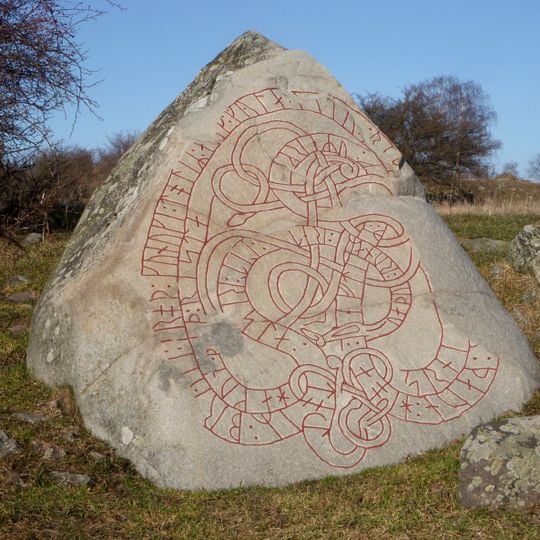
Uppland Runic Inscription 11, Norse runestone in Hovgården, Sweden
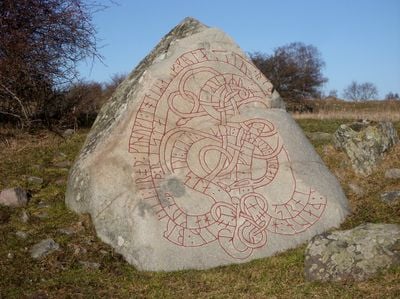
Uppland Runic Inscription 11 is a grey runestone near the ruins of the old king's dwelling at Alsnö hus by Hovgården on Adelsö. Its face bears red-painted knotwork and runic characters in the Pr4 (Urnes) style, with narrow, stylized animals tightly woven into the pattern. The inscription is not signed and names Tolir, a bryte, and his wife Gylla.
U 11 was carved in the 11th century and is linked to King Håkan the Red, who ruled in the 1070s. It commemorates Tolir, a bryte or royal steward at Hovgården, and his wife Gylla, who had the stone raised in memory of a man named Håkon. The inscription is unsigned and cut in the Pr4 (Urnes) style.
The stone was raised by Tolir, a bryte — a foreman of thralls, a word tied to "break", as in breaking bread, so he served out food — and his wife Gylla, in memory of a man. The inscription names a kunungr, King Håkan the Red, placing Tolir's office in the royal administration of the 1070s.
The stone stands by the ruins of the old royal dwelling at Alsnö hus, near Hovgården on Adelsö; the site is reached by road from the ferry landing on the island. It is recorded in the Fornminnesregistret as a protected ancient monument, so it must not be moved or marked. The red paint in the carving makes the lines and runes easier to follow in flat light.
The stone directly names King Håkan and an official called Tolir, making it a rare written record of the administrative hierarchy from that era. This dual reference to royal and local authority provides insight into how power was distributed and recognized in early medieval Sweden.
The community of curious travelers
AroundUs brings together thousands of curated places, local tips, and hidden gems, enriched daily by 93,364 contributors worldwide.