Statue of Carl XIII, Stockholm, Bronze sculpture in Kungsträdgården, Stockholm, Sweden
The Statue of Carl XIII stands in Kungsträdgården, Stockholm, cast in bronze by the Carbonneau foundry in Paris. The king is shown standing, his right arm resting on an anchor, wearing Swedish dress with a mantle fastened at the left shoulder, the Seraphim Order star and the Grand Cross of the Sword on his breast, and a laurel wreath on his head. The black marble pedestal sits on a stepped granite base with four corner plinths, each carrying a bronze lion by Bengt Erland Fogelberg, added in 1824.
Sculptor Erik Gustaf Göthe created the monument, officially unveiled on November 5, 1821, during the reign of Charles XIV John. The four lions were added later by Bengt Erland Fogelberg and combined both Norwegian and Swedish heraldic symbols.
Stockholm wits mocked the statue early on: because Charles XIV John turned the leafy Kungsträdgården into an open gravel square around it, they called it "a gardener without a garden, just as he was a king without honour". A guard was once posted to stop children from riding the lions.
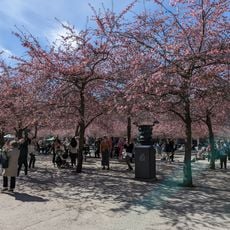
The statue stands mid-park on Kungsträdgården's gravel ground, with the four lions on their granite corner plinths at eye level around the stepped base. A guard was once posted to stop children from riding the lions; the bronze is now patinated and the black marble pedestal shows weathering. The park is open at all hours, and the monument is reached on foot from Hamngatan or the Kungsträdgården metro entrance.
Each of Bengt Erland Fogelberg's four lions, set up in 1824, holds a ball under one paw: two balls carry Sweden's three crowns and two carry Norway's battle axe, marking Karl XIII's rule over both kingdoms from 1814 until 1818. A guard was initially posted to stop children from riding the lions.
The community of curious travelers
AroundUs brings together thousands of curated places, local tips, and hidden gems, enriched daily by 93,172 contributors worldwide.