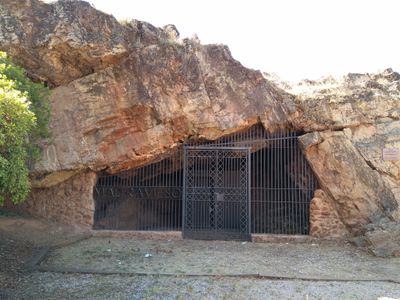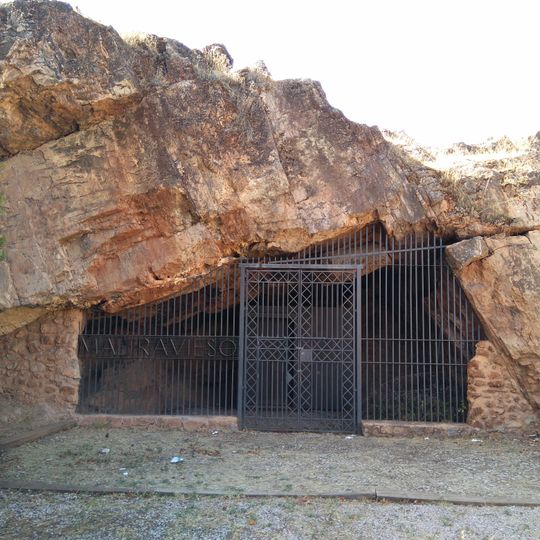
Cave of Maltravieso, Paleolithic cave with rock art in Cáceres, Spain
The Cave of Maltravieso is a Paleolithic site in Cáceres with hand stencils on its limestone walls, spanning roughly 100 meters in length with red pigmentation surrounding the impressions. These paintings were created by Neanderthals and date to around 66,700 years ago.
The site was discovered in 1951 during limestone quarrying work, uncovering human remains and ceramic artifacts. Later research using uranium-thorium dating showed that people occupied the cave as far back as 350,000 years ago.
The hand stencils were created by blowing pigment around open palms, leaving negative impressions that served as personal marks in this underground space. This technique shows how Neanderthals used the cave as a place where they left traces of their presence.
The Interpretation Center offers guided tours to help visitors understand the hand stencils and their archaeological context. Tours allow you to see the paintings up close and learn about the scientific methods used to date the site.
The hand stencils were not necessarily all made at the same time, but may have been layered over a longer period as different groups returned to the cave. This overlapping suggests the site held meaning across multiple generations of Neanderthals.
The community of curious travelers
AroundUs brings together thousands of curated places, local tips, and hidden gems, enriched daily by 92,214 contributors worldwide.