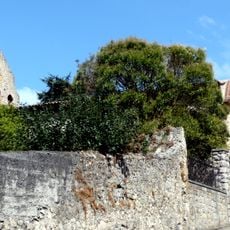
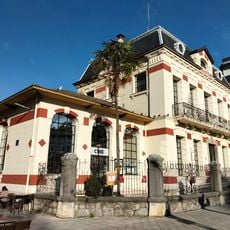
Old town hall of Laredo, Medieval old town in Laredo, Spain
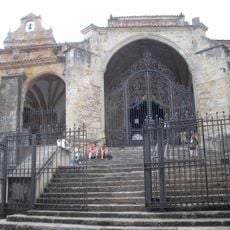
The Puebla Vieja de Laredo is the old town of Laredo, made up of six original streets and the Arrabal. Three streets run south to north up the slope of the Atalaya (Ruamayor, San Marcial, Santa María) and three cross them west to east (San Martín, Rúa del Medio, Ruayusera). A rectangular wall of about 160 by 140 metres enclosed it, and the gates of San Marcial and San Martín survive. The church of Santa María de la Asunción stands above the whole.
Laredo received a charter from King Alfonso VIII of Castile in 1200, making it one of the Four Maritime Villas and spurring its growth from a fishing village into a port town. The medieval core was laid out on six orthogonal streets within a rectangular wall of about 160 by 140 metres, of which the San Marcial and San Martín gates survive. The Arrabal expanded outside the walls from the 14th century, and the town was declared a Historic-Artistic Site in 1970.
The medieval quarter remains a working residential area where locals move through narrow streets lined with stone buildings and open onto small plazas. The church of Santa Maria de la Asuncion stands as a central gathering point that continues to serve the community.
The medieval quarter is best explored on foot, with entry through either of the two preserved gates in the surrounding walls. Comfortable shoes are helpful since the narrow streets have varied elevation and all sites within the area are accessible from a central location.
The 13th-century port at the foot of the quarter had two parallel walls around a wide dock, fortified with crenellated walls and guarded by a tower called La Taleta. In the second half of the 19th century sand deposits reduced its depth, and it was buried under the town's expansion driven by the canning industry.
The community of curious travelers
AroundUs brings together thousands of curated places, local tips, and hidden gems, enriched daily by 94,973 contributors worldwide.