Royal Gate, Historic garden gate at Real Botanic Garden, Madrid, Spain
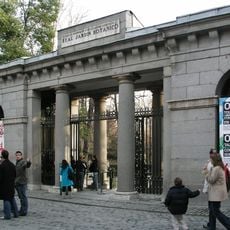
The Royal Gate, also called the Gate of Charles III, is a late-18th-century monument on the Paseo del Prado forming part of the Royal Botanical Garden's enclosure. It is built of granite ashlar with some limestone elements: a central semicircular arch crowned by a pediment, flanked by two linteled side doors. On the Paseo del Prado face, a rectangular panel on two Doric columns bears an inscription naming Charles III and 1781.
Designed by Francesco Sabatini in 1773 as part of Carlos III's Royal Botanical Garden project, the gate opened in 1781. It served as the main entrance only briefly before Juan de Villanueva's 1785–1789 redesign shifted access to the Puerta de Murillo. The gate has remained closed and functions as a monument.
The gate is also called Puerta de Carlos III, and its Paseo del Prado face carries a rectangular panel on two Doric columns with an inscription naming the king and 1781, the year it opened. It now stands closed as a monument; garden visitors enter through the Puerta de Murillo, next to the Prado Museum.
The gate stands on the Paseo del Prado, forming part of the Royal Botanical Garden's perimeter wall. It stays closed, so visitors enter the garden through the Murillo Gate, on the square of the same name beside one of the Prado Museum's facades. From the Paseo del Prado you can see the inscription panel facing the avenue.
The gate is permanently closed and serves only as a monument; visitors enter the Royal Botanical Garden through the Murillo Gate, next to the Prado Museum. On the Paseo del Prado side, a rectangular panel on two Doric columns records Carlos III and the year 1781.
The community of curious travelers
AroundUs brings together thousands of curated places, local tips, and hidden gems, enriched daily by 93,712 contributors worldwide.