Four Fountains, Madrid, Neoclassical fountain complex in Paseo del Prado, Spain
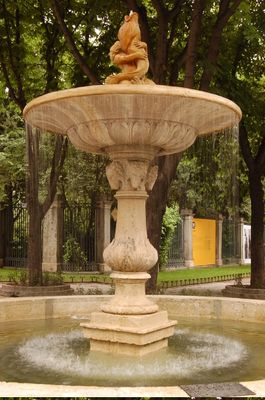
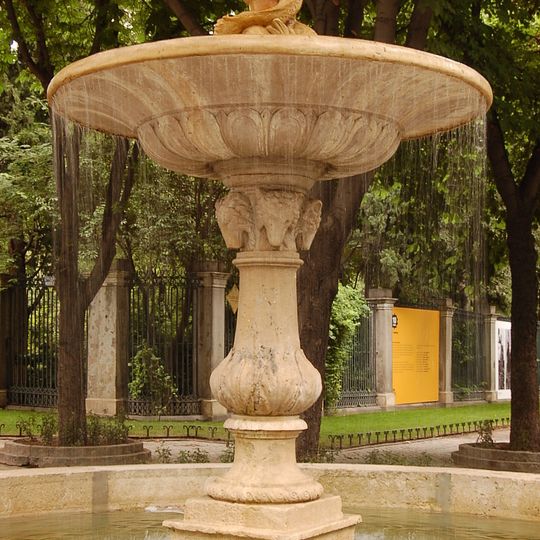
The Four Fountains are four identical small fountains made of limestone from Colmenar de Oreja, arranged around the junction of Plaza de Murillo and Paseo del Prado. Each has a circular basin, a carved column with bear heads from Madrid's coat of arms, and a cup topped by a child triton embracing a dolphin whose mouth spouts the water. The original sculptures, by Francisco Gutiérrez and Alfonso Giraldo, were replaced in 1996 by epoxy resin replicas now kept in the Museo de los Orígenes.
The four fountains were built in the last third of the 18th century as part of the Salón del Prado, the urban project promoted by King Charles III. Ventura Rodríguez designed them in 1781, and sculptors Narciso Aldebó, José Rodríguez, Roberto Michel, Francisco Gutiérrez Arribas and Alfonso Giraldo Bergaz carved them, the last two making the main sculptural groups. In 1996 the originals were replaced by epoxy resin replicas and moved to the Museo de los Orígenes.
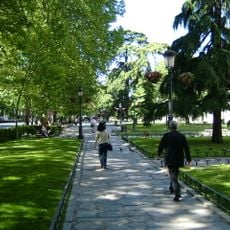
Locals call them Las Fuentecillas, and each fountain carries the heraldic shield of Madrid, including carved bears' heads on the column above the circular basin. The four are arranged as an imaginary square crossed by a traffic lane of the Paseo del Prado, two on the Prado Museum sidewalk and two facing them on the pedestrian median.
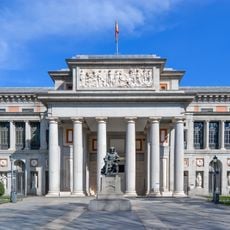
The fountains are accessible year-round and lie within walking distance of the Prado Museum along Paseo del Prado. Visitors can move freely through the area without worrying about access restrictions or specific entry points.
The four fountains are not identical originals: in 1996 the sculptural groups were replaced by epoxy resin replicas because of their poor condition. The originals are now kept at the Museo de los Orígenes in Madrid. Each figure is a child triton embracing a dolphin, whose mouth serves as the water spout.
The community of curious travelers
AroundUs brings together thousands of curated places, local tips, and hidden gems, enriched daily by 93,676 contributors worldwide.