Calares del Mundo y de la Sima Natural Park, Protected natural area in Albacete Province, Spain
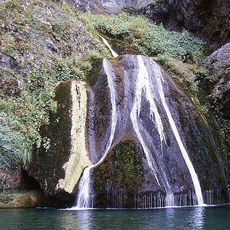
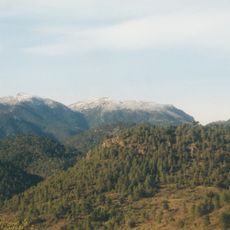
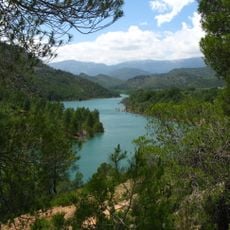
Calares del Mundo y de la Sima Natural Park is a protected area in Albacete Province, Spain, built around limestone plateaus, deep gorges, and one of the largest karst landscapes on the Iberian Peninsula. The Mundo River has its source here and drops as a waterfall into a deep hollow, surrounded by cave systems and sinkholes carved into the rock.
The park was declared a protected natural area in 2005, covering 19,192 hectares across the municipalities of Cotillas, Molinicos, Riópar, Vianos, Villaverde de Guadalimar and Yeste. It comprises the Calar del Mundo, Calar de en Medio, Chorros del río Mundo, Poljé de la Cañada de los Mojones, Sierra del Cujón and Calar de la Sima. Its limestone plateaus and gorges result from water erosion over millions of years.
The park's name comes from its two main limestone plateaus, the Calar del Mundo and the Calar de la Sima, and from the Mundo River, whose source lies within the protected area. The six municipalities that share the park—Cotillas, Molinicos, Riópar, Vianos, Villaverde de Guadalimar and Yeste—are spread across the old Sierra de Alcaraz district. The Pinguicula mundi, a carnivorous butterwort, was first described from these mountains and carries the river's name.
The park covers 19,192 hectares across the municipalities of Cotillas, Molinicos, Riópar, Vianos, Villaverde de Guadalimar and Yeste, so plan which entrance suits your route. Trails are uneven and wet near the Chorros del río Mundo and in the cave areas, so wear sturdy, waterproof footwear. Visitor centres in these villages help with route planning and advise on easier or harder paths.
The park's most singular plant is Pinguicula mundi, a butterwort named after the Mundo River and described from these mountains. It grows on wet limestone walls and rock ledges, and its pale violet flowers trap small insects on sticky leaves. The park also shelters the rare butterfly Graellsia isabellae, the Spanish moon moth, among its more than 140 catalogued invertebrates.
The community of curious travelers
AroundUs brings together thousands of curated places, local tips, and hidden gems, enriched daily by 93,362 contributors worldwide.