Tómbolo de Trafalgar, Natural monument on the southern coast in Cádiz, Spain.
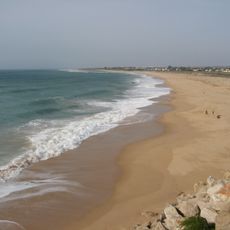
Tómbolo de Trafalgar is a natural sandy spit on the southern coast of Cádiz that connects the mainland to a small islet topped by a lighthouse. This formation developed through the accumulation of sediment and creates a distinctive landscape between the shore and open sea.
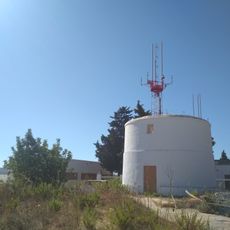
The cape gave its name to the Battle of Trafalgar, fought off these coasts in 1805. On the promontory by the lighthouse lie several archaeological sites: a Roman fish-salting factory and a Muslim settlement. Beside the lighthouse stand the remains of the Torre de Trafalgar, a 16th-century watchtower. In 2018 the remains of a Roman-era building were found in a zone of the tombolo reachable only at low tide.
On the lighthouse promontory at Cape Trafalgar, archaeologists have identified a Roman fish-salting factory and a Muslim settlement. Beside the lighthouse stand the remains of the Torre de Trafalgar, a 16th-century watchtower. In 2018, remains of a Roman-era building were found in a part of the tombolo reachable only at low tide.
Access is from Los Caños de Meca, in the municipality of Barbate, via the A-2233 road. The Roman remains found in 2018 lie in a zone of the tombolo that can only be reached at low tide, so check the tide before crossing. The lighthouse promontory holds the archaeological sites and the ruins of the 16th-century watchtower.
The 2018 discovery of Roman building remains lies in a zone of the tombolo reachable only at low tide, so the isthmus itself holds archaeology. On the lighthouse promontory, digs have revealed a Roman fish-salting factory and a Muslim settlement, plus the ruins of the 16th-century Torre de Trafalgar watchtower beside the lighthouse.
The community of curious travelers
AroundUs brings together thousands of curated places, local tips, and hidden gems, enriched daily by 95,035 contributors worldwide.