Puente viejo de Zamora, Medieval stone bridge ruins near Olivares district in Zamora, Spain.
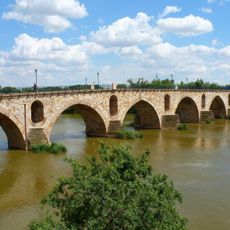
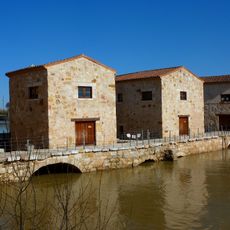
Puente viejo de Zamora, also called Puente de Olivares, was a stone bridge over the Duero. Its remains, visible above the water close to the aceñas de Olivares, linked the Olivares quarter with the extraponte neighbourhoods; the city exit was through the puerta óptima on the bridge's right bank.
The Puente Viejo, also called Puente de Olivares, carried the Vía de la Plata over the Duero until its destruction, dated by some sources to the 10th century and by others to the 12th. Historians disagree on whether it fell to floods or was deliberately cut to block Muslim raids; Fernández Duro and Ursicino Álvarez hold that Zamora then had no bridge for up to three centuries, crossed at the vado de don García, until the Puente de Piedra was built upstream in the early 13th century.
The bridge carried the Vía de la Plata and linked the Olivares quarter with the extraponte neighbourhoods, reached from the city through the Puerta Óptima on the right bank. After its ruin, the vado de don García served as the crossing for nearly three centuries.
The stone remains of the old bridge lie in the Douro near the Olivares mills, on the right bank of the river. They are best seen from the riverside path; the ground is uneven, so wear sturdy shoes. The site is open and can be viewed at any time.
The sixteenth-century drawings of Anton Van den Wyngaerde show the bridge already in ruins, with only masonry fragments standing above the water beside the Olivares mills. The popular label 'Roman bridge' was overturned by studies from Miguel Ángel Mateos and Florián Ferrero, who dated the remains to the medieval period.
The community of curious travelers
AroundUs brings together thousands of curated places, local tips, and hidden gems, enriched daily by 94,660 contributors worldwide.