Castillo de Santiago, Medieval castle in Sanlúcar de Barrameda, Spain.
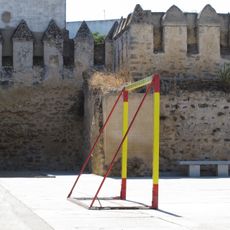
The Castillo de Santiago is a late-Gothic fortress of rammed earth, rubble masonry and ashlar, built on a square plan with a barbacane and towers around a central parade ground. In the northeast corner stand the aula maior, roofed by a brick vault painted with the builder duke's segur emblem, and the hexagonal homage tower modelled on the Torre de Guzmán at Tarifa.
The Castillo de Santiago was built in 1477–1478 by the House of Medina Sidonia under Enrique Pérez de Guzmán y Meneses, II Duke of Medina Sidonia and VII Lord of Sanlúcar. It occupied the northeast corner of the citadel begun under Guzmán el Bueno, first Lord of Sanlúcar, on the edge of the ravine dividing the town. It was declared a monument in 1972; restoration from 2003 followed an earlier campaign by the Tartessos workshop school (1989–1991).
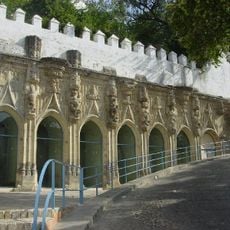
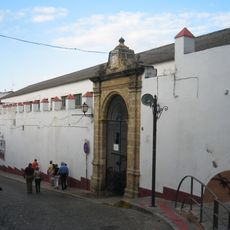
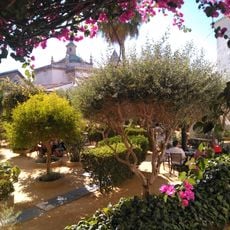
The castle displays Gothic features with mud walls and stonework surrounding a central courtyard. The north gate is decorated with a triton and heraldic shields that reflect the noble past of the place.
The building is easily visible from the river and lies within walking distance of the town center. Visitors should allow time to explore the museums inside, which feature costumes and historical maps showing the site's importance to the region.
The lower walls carry a collection of old graffiti and stonecutters' marks that record how the castle was built. The north gate, called the "puerta de la Sirena", is signed at the base of one of its mouldings by "Marinu de Nea", probably Marinus de Neapoli, suggesting a Neapolitan sculptor.
The community of curious travelers
AroundUs brings together thousands of curated places, local tips, and hidden gems, enriched daily by 93,451 contributors worldwide.