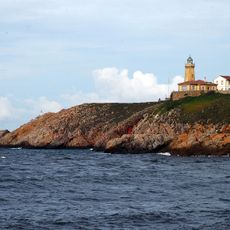
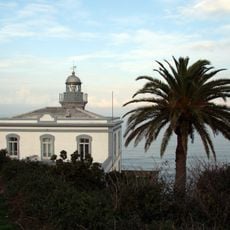
Faro de Cabo Peñas, Maritime lighthouse at Cape Peñas cliffs, Gozón, Spain.
Faro de Cabo de Peñas stands on the most projecting plateau of Cape Peñas, in Gozón, Asturias, 100 m above the sea and about 60 m from the cliff edge. Its square, three-storey building is painted white with a red-tile roof, and an unpainted grey stone tower with gallery and lantern is attached to the north facade. The tower is octagonal and 18 m tall, with a focal plane 117 m above sea level.
The lighthouse entered service on 15 August 1852 on the Cabo Peñas promontory, in the parish of Candás, Gozón. It was electrified in 1946, received a foghorn in 1951 (modernised in 1977), a radiobeacon in 1956 and a DGPS station in 2003. The 1852 lantern was bought at the 1929 Barcelona Universal Exposition.
The lighthouse is still home to a keeper, one of the few inhabited lighthouses in Spain; the 2000 documentary by Eugenio Monesma interviews keeper José Luís García about the daily work of lighting and maintenance. The ground floor houses the Centro de Recepción de Visitantes e Interpretación del Medio Marino de Peñas (MEMAP), a museum on the marine environment.
The lighthouse stands on the most projecting plateau of Cape Peñas, in the council of Gozón, about 8 km north-west of the town; the access road ends at the cape's protected area. The ground floor houses the marine environment visitor centre (MEMAP). The cape is the northernmost point of Asturias and is exposed to wind and sea mist, so bring warm, waterproof clothing.
The 1852 lantern now in use was bought at the 1929 Barcelona International Exposition. The light shows a group of three flashes and reaches 41 nautical miles in clear weather, dropping to 18 in haze; the French source gives 35 miles. A foghorn added in 1951 sounds the Morse letter P every 60 seconds.
The community of curious travelers
AroundUs brings together thousands of curated places, local tips, and hidden gems, enriched daily by 93,454 contributors worldwide.