Castle of Santa Bárbara, Zaragoza, Medieval fortress and hermitage site in Zaragoza, Spain.
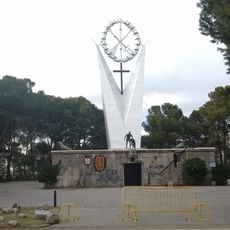
Castle of Santa Bárbara is a ruined fortress complex on a hill with remnants of defensive walls and religious structures that overlook the city. The site consists of stone remains and foundations that show centuries of different uses and modifications.
The castle was built in the 13th century as part of the defensive perimeter of Saracusta, alongside fortresses such as Juslibol, Miranda and Alfocea, until Alfonso I the Battler reconquered the city in 1118. Most of the structure disappeared when a hermitage was built over its ruins in the 17th century. In 1690 a brotherhood of Zaragozan farmers founded the Cofradía de la Gloriosa Santa Bárbara, and the hermitage appears in its records in 1691. The building was destroyed in the Spanish Civil War of 1936 and never restored; in 1946 the brotherhood moved its pilgrimage to the church of Miralbueno.
The hermitage was founded in 1690 by a brotherhood of Zaragozan farmers, the Cofradía de la Gloriosa Santa Bárbara, based at the parish of San Pablo. Its 1 May pilgrimage blessed the fields until it was moved to the Miralbueno church in 1946, when the hermitage was abandoned.
Access is through an adjacent park with a walking route up the hill, though terrain accessibility varies depending on weather conditions. Comfortable footwear is recommended, and it is best to allow time for both the climb and exploring the site.
The hermitage that absorbed most of the castle was built after 1690, when a group of Zaragozan farmers founded the Cofradía de la Gloriosa Santa Bárbara, based in the parish of San Pablo. The chapel appears in the brotherhood's Libro de Resoluciones in 1691, and in 1706 its roof needed repair after damage from the Aragonese capital's weather.
The community of curious travelers
AroundUs brings together thousands of curated places, local tips, and hidden gems, enriched daily by 94,114 contributors worldwide.