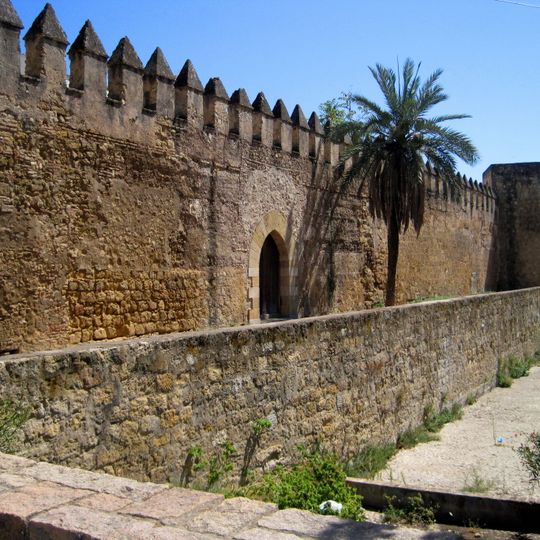
City walls of Córdoba, Roman defensive walls in Córdoba, Spain.
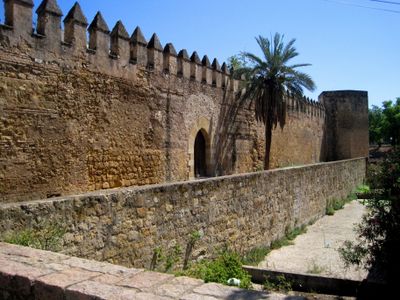
The City walls of Córdoba are defensive structures that surround the ancient town center and feature stone construction with semicircular towers. The structure displays a double-wall system with rubble filling that connects different building periods.
The first walls went up in the 2nd century AD, enclosing about 2,650 m and some 47.6 hectares, with four gates facing the cardinal points. Under Tiberius the southern stretch was demolished so the city could reach the river. After the Fitna of al-Andalus the ruined Roman circuit was rebuilt and a new eastern wall, the Axerquía, was added; in the later 14th century three more enclosures followed.
The walls show Roman and Moorish building techniques, reflecting the different cultures that shaped Córdoba over centuries. You can see these layers today and understand how the city changed under different rulers.
The best-preserved stretches are the 360 m along Calle Cairuán, with seven towers and the Puerta de Almodóvar, and the 410 m of the Huerta del Alcázar's south wall, with six towers including Guadalcabrillas. The Puerta de Sevilla there is a reconstruction, the original having been demolished in 1865. A section of Roman wall is visible from the street beside the Roman temple.
The Roman wall was not a single mass: an outer facing up to 3 m high and an inner wall 1.2 m high flanked a 6 m gap packed with rubble. The surviving base beside Calle Cairuán was restored in the 1950s, so part of what visitors see is 20th-century reconstruction.
The community of curious travelers
AroundUs brings together thousands of curated places, local tips, and hidden gems, enriched daily by 95,316 contributors worldwide.