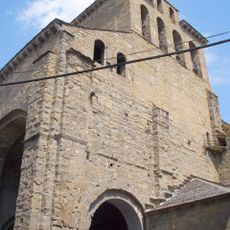
Museo Diocesano de Jaca, Religious art museum in Jaca, Spain
The Diocesan Museum of Jaca occupies rooms around the cathedral cloister, with the lower floor given to Romanesque and Gothic wall painting shown in the refectory and the room for the paintings from the church of Saints Julián and Basilisa in Bagües. The upper floor covers the Gothic and Modern periods, with the Gothic altar frontal from the monastery of Santa María de Iguácel.
The diocese's museum tradition began in 1934 with the Museo Románico, opened in the former Benedictine monastery to display the sarcophagus of Doña Sancha. The current Diocesan Museum was inaugurated on 22 August 1970 in the rooms around the cathedral cloister. It closed in 2003 and reopened on 9 February 2010 after a reform applying the cathedral's Master Plan.
The museum's name refers to the Diocese of Jaca, whose parishes yielded the wall paintings shown here. The room devoted to Bagües preserves frescoes taken from the church of Saints Julián and Basilisa, painted between 1080 and 1096. The Gothic altar frontal from the monastery of Santa María de Iguácel is another piece tied to a specific church.
The museum occupies the rooms around the cathedral cloister: the lower floor holds the cloister rooms, the refectory, the Bagüés room and the chapter house, while the upper floor has the Secretum room and the former library. Access is through the cathedral complex in Jaca, Aragón.
The Bagüés paintings were made between 1080 and 1096, not in the 13th century, and come from the church of Saints Julián and Basilisa in Bagüés (Zaragoza). They fill a room of their own on the lower floor, next to the refectory, and are counted among the jewels of European Romanesque art.
The community of curious travelers
AroundUs brings together thousands of curated places, local tips, and hidden gems, enriched daily by 94,369 contributors worldwide.