Castle of Feria, Medieval castle in Feria, Spain.
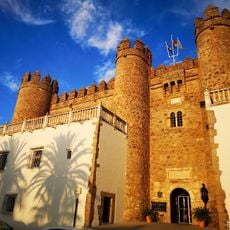
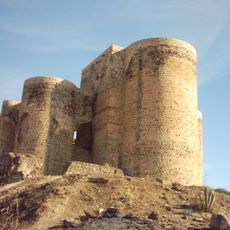
The Castle of Feria is a fortress sitting on a hilltop with thick defensive walls and rounded corner towers that follow the terrain's shape. The structure forms a compact, fortified complex designed to dominate the surrounding landscape.
The castle began as a Moorish fortress in the 11th century and underwent major reconstruction over time. In 1394, King Henry III granted the territory to Gomes Suarez de Figueroa, transforming it into a family seat of regional power.
The castle's name comes from the Casa de Feria, the noble house of the Suárez de Figueroa, whose vast territory included Zafra and other towns. The fortress kept visual contact with the castles of Villalba de los Barros, Zafra and Nogales, communicating by fire or sun reflections. The site was called Seria by the Celts and Seridja by the Arabs.
The castle occupies about 7,000 square metres on a conical hilltop above the village, with the walled enclosure following the irregular terrain. The keep has no door at its base: the living floors are reached from the wall walk, so access is by uneven paths and steps. The surrounding plain is flat for kilometres, giving long sightlines toward Zafra, Villalba de los Barros and Nogales.
The keep's lower level has no doors: entry to its living floors was made from the adjoining wall, so attackers who reached the base found no way in. The tower stands 40 m high with 18 m sides, and a channel carried rainwater from its top down to the main cistern in the basement.
The community of curious travelers
AroundUs brings together thousands of curated places, local tips, and hidden gems, enriched daily by 95,298 contributors worldwide.