Puente Enrique de la Mata Gorostizaga, Viaduct at Paseo de la Castellana, Madrid, Spain.
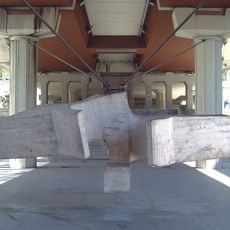
Puente Enrique de la Mata Gorostizaga is a 230-metre viaduct of eight spans over Paseo de la Castellana, linking Juan Bravo and Eduardo Dato streets. Its deck rests on two Corten steel box girders and a white reinforced concrete slab 16 metres wide, with a 12-metre asphalt roadway and two 2-metre sidewalks. The supports are white concrete columns with U-shaped, prismatic or truncated-pyramid capitals.
The viaduct was proposed to mayor Carlos Arias Navarro during the 1950s urban expansion, when Paseo de Eduardo Dato (formerly del Cisne) needed a link to Juan Bravo street. Engineers José Antonio Fernández Ordóñez, Julio Martínez Calzón and Alberto Corral placed the supports on deep beams to avoid loading the vault of Rubén Darío station on Metro Line 5, which runs beneath the Castellana.
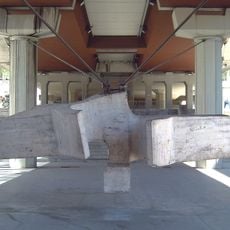
The open-air abstract sculpture museum on the last three spans was made by the engineers with sculptor Eusebio Sempere and was completed in 1978 with the installation of La sirena varada (Encuentros III) by Eduardo Chillida. The walkway is known locally as the Juan Bravo or Eduardo Dato bridge, after the two streets it links.
The viaduct is open daily to car traffic and pedestrians, linking different parts of the city. It works best to visit during daytime when you can see the artworks clearly and observe the surrounding urban flow.
The railings were designed by sculptor Eusebio Sempere and feature abstract shapes resembling the letter O throughout. This artistic treatment of a functional element turns the viaduct into more than just a traffic structure.
The community of curious travelers
AroundUs brings together thousands of curated places, local tips, and hidden gems, enriched daily by 94,689 contributors worldwide.