Cerro Almodóvar, inselberg in Vicálvaro, Madrid, Spain
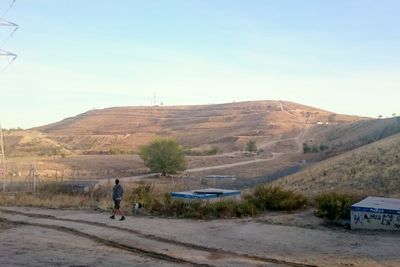
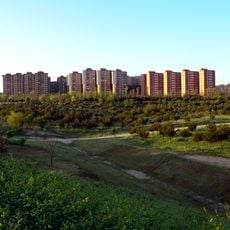
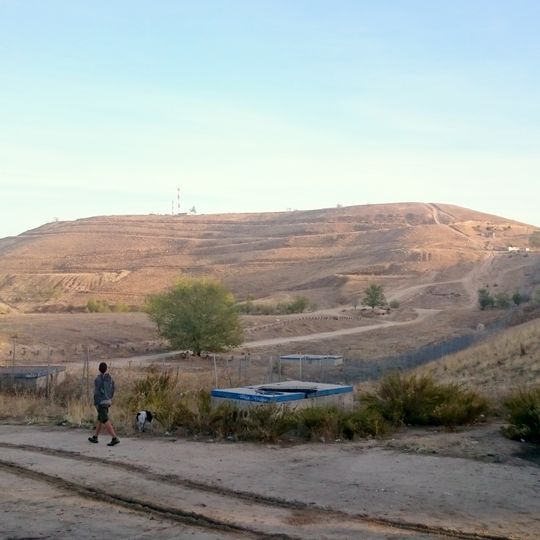
Cerro Almodóvar is a witness hill (cerro testigo) in the Vicálvaro district of Madrid, near the boundary with Villa de Vallecas. Its base contains sepiolite quarries, while the summit is covered with flint mixed with chalcedony, resin opal, white opal and spathic calcite. A geodetic vertex installed in November 1974 stands at 726.802 metres above sea level. The hill rises about 63 metres above the surrounding terrain and is roughly 1.4 kilometres wide at its base.
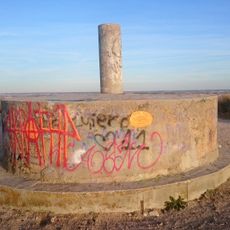
Cerro Almodóvar is a witness hill, a remnant of a formerly more extensive plateau. Its summit holds a geodetic vertex installed in November 1974 at 726.802 metres above sea level, and the hill is listed as a geological point of interest. The slopes were quarried for sepiolite, and fossils of a giant tortoise (Geochelone bolivari) and mammals such as Megacricetodon collongensis have been found near the quarry.
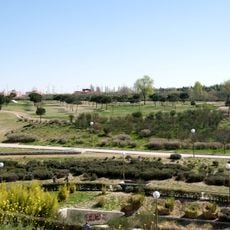
The hill's name comes from Arabic al-mudawwar, 'the round one', a toponym left by the Muslim period of central Iberia. Today the slopes are open esparto and broom scrub, and the old sepiolite quarries at the base, worked for the absorbent clay, remain visible as cut terraces.
The hill lies in Vicálvaro, beside the boundary with Villa de Vallecas, about 9 km east of central Madrid. Bus 78 from Vicálvaro metro station brings visitors to the base, from where a path climbs to the summit. The path is steep in places, so wear suitable footwear and clothing.
The summit's geodesic vertex, installed in November 1974, stands at 726.802 metres above sea level and is listed as a geological point of interest. The top is a mix of flint with chalcedony, resin opal, white opal and sparry calcite.
The community of curious travelers
AroundUs brings together thousands of curated places, local tips, and hidden gems, enriched daily by 93,470 contributors worldwide.