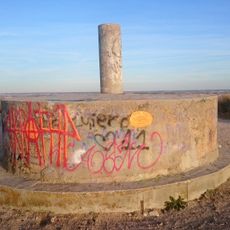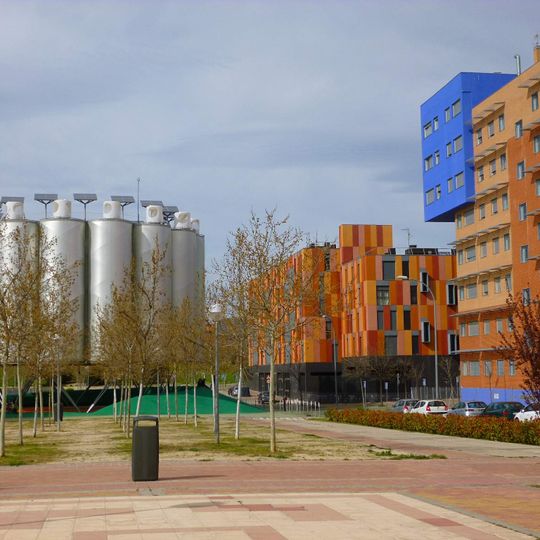
Eco-Boulevard, Sustainable architectural structure in Ensanche de Vallecas, Spain
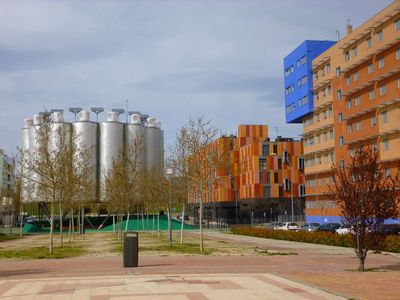
The Eco-Boulevard is a sustainable architectural structure with three cylindrical pavilions that integrate solar panels and evaporative cooling systems along a pedestrian-friendly route. The installation spans a large area and combines walkability with innovative technologies for temperature control.
The Eco-Boulevard was built between 2004 and 2007 on the Bulevar de la Naturaleza, a 550 by 50 metre avenue in the western half of the Ensanche de Vallecas. Madrid's municipal housing office launched an ideas competition in 2004, won by Belinda Tato's firm Ecosistema Urbano with backing from the EU LIFE-2002 programme. The scheme won the AR Award in 2007.
The three pavilions are called "air trees" and were conceived as open supports for activities chosen by users, not programmed by the city. Their use was meant to be temporary: once social activity and climate comfort were corrected, they would be dismantled, leaving clearings in the forest formed by the planted trees.
The three air trees stand on the western half of the Ensanche, along a 50-metre-wide, 500-metre-long north-south avenue. Their cooling by evapotranspiration lowers temperatures by around 10 degrees, but only depending on the humidity and temperature of the moment. The walkways on the five polygonal rings are reserved for maintenance, so visitors stay at ground level.
The pavilions are intentionally temporary and can be dismantled once natural vegetation in the area reaches maturity. This shows an innovative approach where the infrastructure fulfills its purpose and makes itself obsolete.
The community of curious travelers
AroundUs brings together thousands of curated places, local tips, and hidden gems, enriched daily by 94,044 contributors worldwide.