Puente de Liérganes, Stone bridge in Liérganes, Spain.
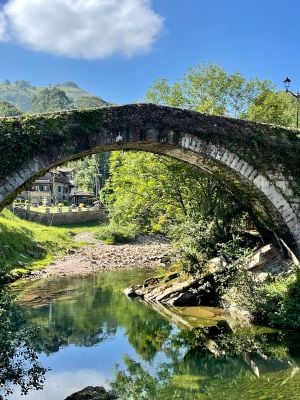
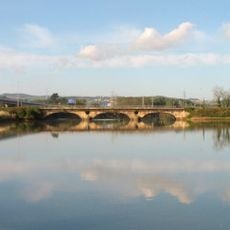
The Puente de Liérganes is a stone bridge spanning the River Miera in the town of Liérganes in northern Spain. Its solid arched construction connects the two sides of the town and displays the straightforward building methods typical of local infrastructure from earlier periods.
A medieval bridge already stood here before the current one, which the Rubalcaba family commissioned. Bartolomé de Hermosa designed it in 1587 and it opened in 1606, part of Cantabria's shift from wooden to stone bridges. Rucandio refused to pay, but the Valladolid court ordered the two towns to split the cost; in 1612 some locals were jailed over the dispute.
Locals wrongly call it the "Roman bridge", though the present structure was designed by Bartolomé de Hermosa in 1587 and opened in 1606. Beside one abutment stands a statue of the fish-man (hombre pez), a figure of Cantabrian legend, and the 1667 mill next door has housed the fish-man interpretation centre since 2009.
The bridge links the El Mercadillo and El Calgar quarters of Liérganes, crossing the Miera. The statue of the fish-man stands at one of its abutments, and the 1667 mill, now the fish-man interpretation centre, is beside it. The arch underside is mossy, so the paving can be damp after rain.
Locals call it the "puente romano", but it was designed by Bartolomé de Hermosa in 1587 and opened in 1606. The neighbouring village of Rucandio refused to pay towards it; the dispute reached the court of Valladolid, which ordered the two towns to split the cost, and in 1612 some locals were jailed over the affair.
The community of curious travelers
AroundUs brings together thousands of curated places, local tips, and hidden gems, enriched daily by 95,030 contributors worldwide.