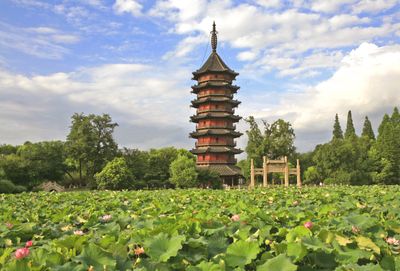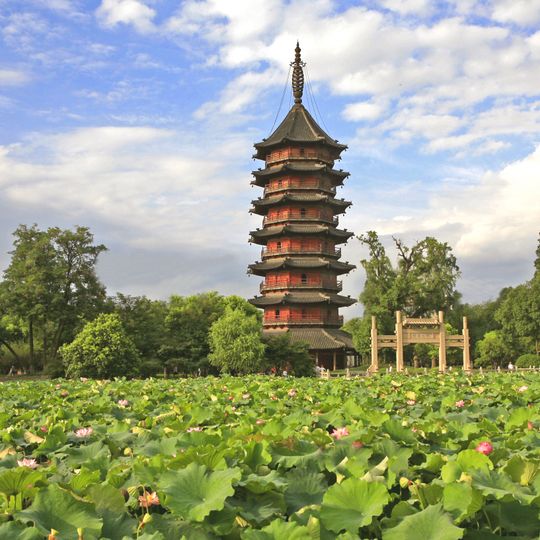
Feiying Pagoda, Buddhist pagoda in Huzhou, Zhejiang, China
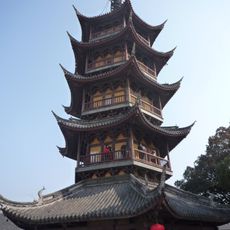
Feiying Pagoda is a brick-and-wood pavilion-style pagoda with a seven-story octagonal outer tower, 55 meters tall and 11 meters in diameter, enclosing a five-story octagonal stone inner tower now 15 meters high. The outer tower has balconies on its second to fourth floors supported by dougong brackets, and the inner stone tower rests on a Xumizuo base carved with lotus flowers and lions.
The inner tower was constructed between 884 and 894 CE by a monk who collected seven relics and Buddhist treasures from Chang'an. The outer tower was added later, providing a protective enclosure around the original structure.
The name Feiying comes from the Buddhist phrase "sheli feilun, yingguang puxian" (relics fly like a wheel, brilliant light shines everywhere), chosen after the outer wooden tower was added. The fame of the "pagoda within a pagoda" led Shangcheng Temple to be renamed Feiying Temple in 1005. Look for donor inscriptions carved on the inner stone pagoda's pillars.
The outer brick-and-wood tower has stairs on its inner wall leading up through seven storeys, with encircling galleries on the second to fourth floors. The site reopened in June 2009 after restoration; the ticket price was the subject of a public hearing held by Huzhou's development commission in April 2015.
During the 1982–1986 restoration, workers found a collapsed black-lacquer wooden sutra box inlaid with mother-of-pearl hidden in the outer pagoda's wall. It held a damaged copy of the Lotus Sutra and 566 Zhouyuan Tongbao coins, all identified as Five Dynasties pieces.
The community of curious travelers
AroundUs brings together thousands of curated places, local tips, and hidden gems, enriched daily by 94,095 contributors worldwide.