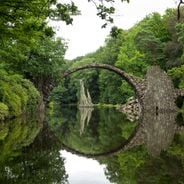
Hongji Bridge, Stone arch bridge in Nanxun, Huzhou, China.
Hongji Bridge is a stone arch structure that crosses the Dongshi River in Nanxun Ancient Town, connecting different sections of the historic area. The rounded arch rises above the water and supports a flat walking surface for pedestrians passing through.
Hongji Bridge is first recorded in the Wanli-era Prefecture Topography of Huzhou, so it existed by the Ming dynasty; its original construction date is unknown. Local people rebuilt it in 1805, the tenth year of the Jiaqing reign. On 15 November 1937 the National Army blew up part of the deck to stop the Imperial Japanese Army advancing on Huzhou, and the bridge was later repaired.
Locals call it Xinqiao, the "New Bridge", though it is first recorded in the Ming dynasty Wanli-era Huzhou Prefecture Topography. Its north landing opens onto Dongda Street, a short walk from the former residence of Zhang Jingjiang; the south landing meets Xiatang East Street. The single arch has 33 steps on each side.
The bridge is easy to reach on foot and open to visitors exploring Nanxun Ancient Town at any time. Walking across during daylight hours gives the best views of the surrounding water and town architecture.
The bridge is also known as Xinqiao, or "New Bridge", though it appears in the Wanli-era Huzhou Prefecture Topography. Its north landing opens onto Dongda Street, a short walk from the former residence of Zhang Jingjiang, and the south landing onto Xiatang East Street. It has 33 steps on each side.
The community of curious travelers
AroundUs brings together thousands of curated places, local tips, and hidden gems, enriched daily by 93,847 contributors worldwide.