Tomb of Yu Qian, Ming dynasty tomb in West Lake district, China
The Tomb of Yu Qian is a Ming dynasty burial site located near West Lake in Hangzhou. The memorial complex displays stone carvings, inscriptions, and traditional architectural features that reflect burial customs and daily practices from the 15th century.
Yu Qian (1398–1457), a Qiantang native and Ming war minister, helped place Zhu Qiyu on the throne and led the defence against the Oirat invasion after the Tumu crisis. In 1457 the restored Yingzong had him executed for treason; officer Chen Kui recovered the body. In 1459 his son-in-law Zhu Ji moved the coffin to the family cemetery at Santai Hill, where seven graves were built with Yu Qian's at the centre.
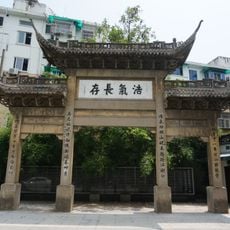
The stone archway at the start of the 90-metre spirit path bears the inscription "热血春秋" (Rexue Chunqiu), four characters honouring Yu Qian's loyalty. Beside the tomb stands the Jinggong Shrine, built in 1489 by order of the Hongzhi Emperor; its rear hall keeps Ming steles, including the 1541 record of the shrine's restoration.
The tomb lies at the foot of Santai Mountain on the south shore of West Lake in Hangzhou's Xihu District. The grounds measure about 23 metres wide and 30 metres long, with a 90-metre spirit path running east from the three-gate stone archway to the horseshoe-shaped mound. The adjacent Yu Qian Shrine holds an exhibition on his life; its rear hall keeps Ming steles from 1489 and 1541.
The tomb originally stood at the centre of seven family graves, but only Yu Qian's was rebuilt in 1982; the stele inscription was written by calligrapher Sha Menghai. The 90-metre spirit path and its six pairs of stone figures were recreated in 1998 following Ming dynasty rules.
The community of curious travelers
AroundUs brings together thousands of curated places, local tips, and hidden gems, enriched daily by 93,823 contributors worldwide.