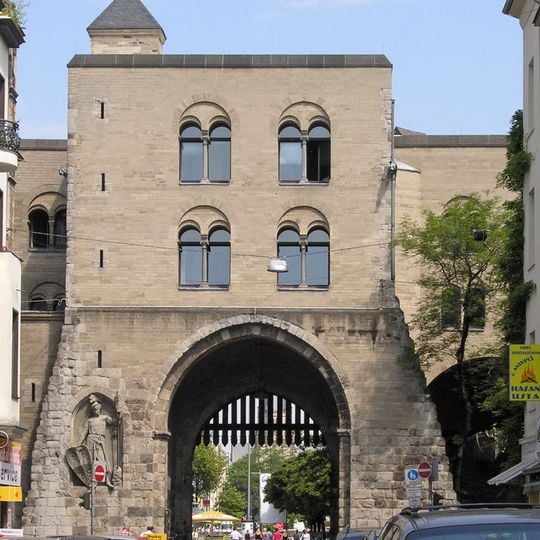
Eigelsteintorburg, Medieval city gate in Altstadt-Nord, Germany.
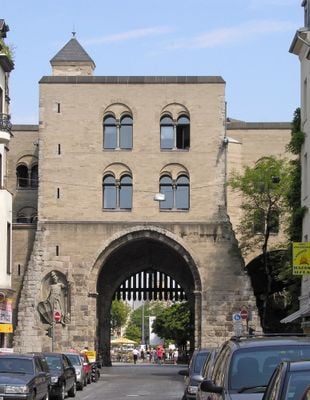
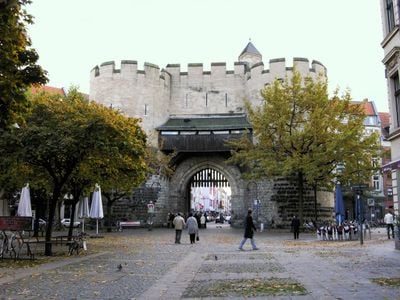
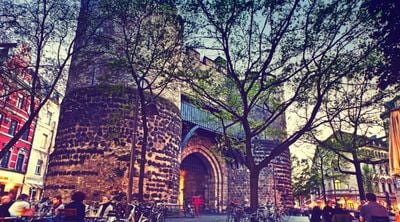
The Eigelsteintorburg is a double-towered gatehouse of the medieval Cologne city wall, built between 1228 and 1248 as the northern entrance on the road from Neuss. Two half-round towers with battlements flank a central passage, and the field-side windows were replaced with medieval arrow slits during Josef Stübben's restoration of 1889–1892.
Built between 1228 and 1248 as the northern entrance to Cologne on the road from Neuss, the gate replaced an earlier Eigelstein gate from the second city expansion, located 100 m to the south. On 13 September 1804 Napoleon and Josephine entered the city through it. After the city wall was demolished in 1882, Josef Stübben restored the gate between 1889 and 1892.
In a niche on the city side stands the stone figure 'Der Kölsche Boor', carved by Christian Mohr in 1885 for the Hahnentor and placed here in 1891. The farmer holds Cologne's city keys and a flail, resting on a shield with the double eagle. Below is carved: 'Halt fass do Kölscher Boor. Bliev beim Rich et fall sös ov sor.'
The gate is easily accessible from street level and sits on a main road through the old town quarter. The interior now serves cultural and event purposes, giving visitors occasional opportunities to see inside the structure.
After World War II, the city's first art exhibition after the war took place here in March 1946. This event marked Cologne's symbolic rebirth and turned the tower into a gathering point for the city's cultural recovery.
The community of curious travelers
AroundUs brings together thousands of curated places, local tips, and hidden gems, enriched daily by 93,116 contributors worldwide.