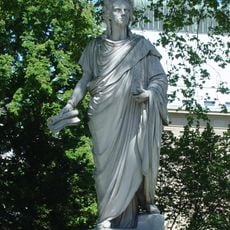
Haus der Geschichte Baden-Württemberg, State history museum in Stuttgart, Germany
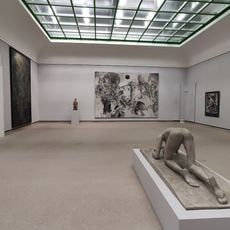
The Haus der Geschichte Baden-Württemberg is a museum on Stuttgart's Kulturmeile, between the Staatsgalerie and the Musikhochschule, in a building by Michael Wilford and Manuel Schupp. Its permanent exhibition holds over 1,500 original objects and more than 1,000 photographs, films and information stations. It is arranged in three parts: an alphabet of 26 objects, a chronological walk through 200 years of state history, and a thematic park on present-day issues.
The House of History Baden-Württemberg was founded on 1 October 1987; from 1992 a small government team showed its first exhibitions on state history at decentralised venues. The building on Konrad-Adenauer-Straße, part of the Stirling-Wilford ensemble and initiated by Erwin Teufel, was planned by Michael Wilford and Manuel Schupp and completed in 2002. The permanent exhibition opened there on 13 December 2002 on more than 2,000 m². State historian Otto Borst, director Thomas Schnabel and exhibition head Paula Lutum-Lenger worked on the project.
The museum uses everyday objects like clothing, kitchen items, and personal photographs to show how ordinary people lived in the region. Many visitors find themselves recognizing things from their own family histories in the displays.
The museum is in central Stuttgart, close to the main train station, and easy to reach on foot from most parts of the city center. It is worth setting aside a good couple of hours, as the exhibition covers several themed rooms and some sections invite visitors to interact directly.
The museum has a dedicated space where visitors can discuss current political and social topics by connecting them to events from the region's past. This room hosts regular public debates, turning the building into a meeting point rather than just a place to look at objects behind glass.
The community of curious travelers
AroundUs brings together thousands of curated places, local tips, and hidden gems, enriched daily by 94,697 contributors worldwide.