Xanten Cathedral, Gothic cathedral in Xanten, Germany.
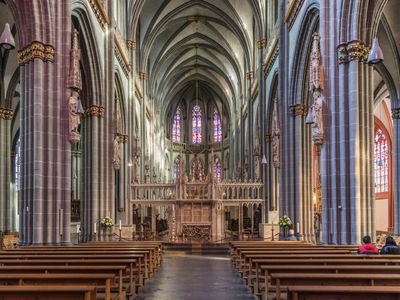
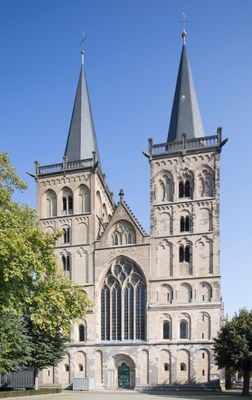
St. Viktor, known as the Xanten Cathedral, is a Gothic church with two west towers 72 and 74 metres high, the left set slightly forward of the right, both topped by dark grey conical spires. Its five-aisle nave has no crossing and no ambulatory, giving an uninterrupted length; the choir is flanked by two pairs of chapels. A rood screen with carved tracery stands before the choir and its tall stained-glass windows.
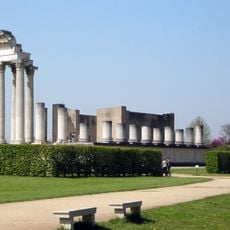
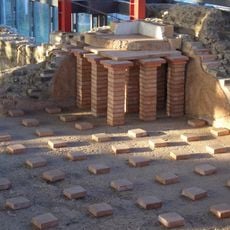
The cornerstone of the present building was laid on 22 August 1263 by Archbishop Konrad von Hochstaden and his brother Friedrich, provost of the Xanten archdeaconry. The Gothic east end was finished by 1437, the west section between 1483 and 1519, and the Holy Spirit Chapel was dedicated in 1544, completing 281 years of work. The church stands over 4th-century graves; a cella memoriae found in excavations was built for two other burials, not for Victor. The monastery was secularised in 1802 under Napoleon.
The name ad Sanctos, 'to the saints', passed from the canons' foundation to the surrounding town and became today's Xanten. The church holds Victor's grave and memorials to modern martyrs, and remains a pilgrimage destination. Its Stiftsbibliothek is one of the Lower Rhine's most important church libraries.
The main entrance is through the three recessed doorways at the base of the west facade; the interior runs lengthwise toward the rood screen and choir. The cloister with its pointed-arch arcades lies on the north side. The towers rise 72 and 74 metres, so the west front is best seen from a distance on the cathedral square.
Despite the title Dom, which usually indicates a bishop's seat, this church was never the main seat of a diocese. This peculiarity makes it an example of how church naming conventions do not always reflect actual status.
The community of curious travelers
AroundUs brings together thousands of curated places, local tips, and hidden gems, enriched daily by 94,530 contributors worldwide.