Fortifications of Braunschweig, Fortification system in Brunswick, Germany
The fortification system of Brunswick is a network of walls, towers, and gates that encircles the medieval old town. The defensive ring encloses major public squares, religious buildings, and historical administrative complexes, revealing the strategic planning of the city's medieval layout.
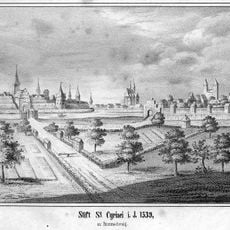
The fortifications developed over roughly eight centuries, from around 1000 to the end of the 18th century. The Altstadt and Neustadt were walled before 1149, the Hagen around 1170 and the Altewiek around 1200; in the 13th century the inner walls were demolished in favour of a common outer wall. Mid-12th century the Oker was diverted into two flood channels around the city, and the walls lost military value around 1769.
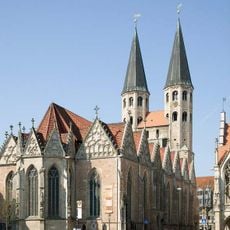
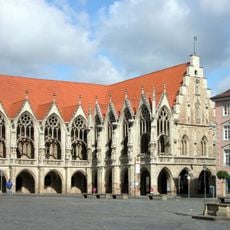
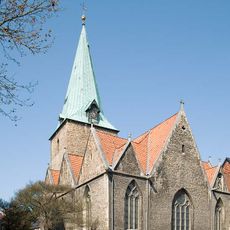
Until 1671 Braunschweig consisted of five legally independent Weichbilde — Altewiek, Altstadt, Hagen, Neustadt and Sack — plus the Aegidienfreiheit and Burgfreiheit. Each had its own council, town hall, parish church and walls, and gates such as the Leuentor, Redingetor and Gildetor linked them. The five Weichbilde kept their independence until the dukes of Braunschweig-Wolfenbüttel recaptured the city in 1671.
Visitors can explore the preserved wall sections on foot, providing a good way to walk between different city neighborhoods. Many gates and towers are freely accessible or located within museums, allowing independent exploration without special preparation.
The Burgplatz lies within the former Burgfreiheit, one of seven independent districts that made up Brunswick until 1671. The castle's own walls were demolished in the 1580s after new districts enclosed it, and its moat survived until 1798, when it was covered and channeled underground to make room for new buildings.
The community of curious travelers
AroundUs brings together thousands of curated places, local tips, and hidden gems, enriched daily by 94,815 contributors worldwide.