Brandungskliff am Steigerberg, Paleocliff formation at Steigerberg, Germany.
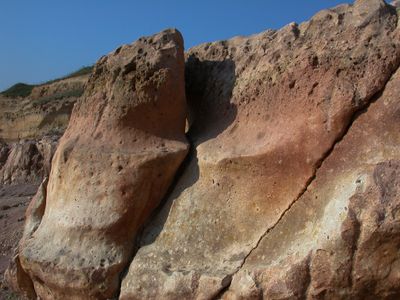
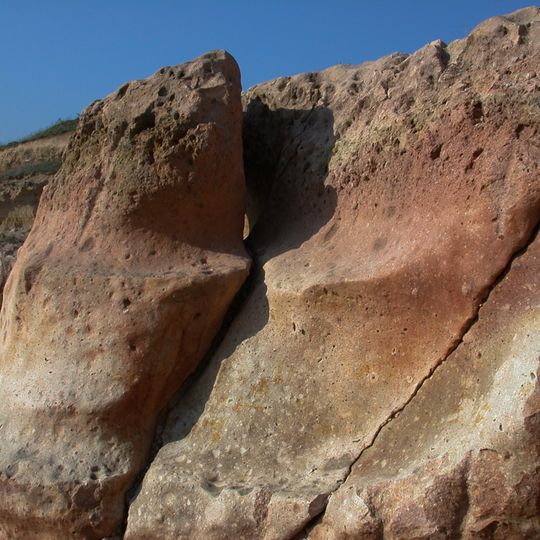
Brandungskliff am Steigerberg is a fossil cliff in a disused gravel pit on the western flank of the Steigerberg, between Eckelsheim and Wendelsheim. The cliff face consists of Kreuznach Rhyolite and is cut into four terrace-like steps, each with a near-vertical wall about 3 to 5 metres high. The walls show horizontal notches and hollows, while the flat surfaces are scored by parallel grooves and potholes.
The cliff was formed about 30 million years ago during the Rupelian transgression, when the sea of the Mainz Basin reached its highest Tertiary level and fully marine conditions prevailed. The underlying Kreuznach Rhyolith dates from the Lower Permian, about 260 million years older. The four terraces record the sea-level rise of the early Rupelian.
The cliff face preserves fossils of oysters (Ostrea callifera), mussels (Perna sanderbergi) and barnacles (Balanus stellaris) that once lived attached to the rock. Visitors can also see horizontal notches interpreted as wave-cut hollows and pot-hole-like depressions on the terraces.
The site sits between Eckelsheim and Wendelsheim villages, southwest of Mainz, positioned on the western slope of Steigerberg. Visitors should wear sturdy footwear since the terrain is steep and conditions can vary depending on weather and ground moisture.
The four terrace levels record the sea-level rise during the early Rupelian transgression, when the Rupel Sea reached its highest stand in the entire Tertiary of the Mainz Basin. On the rock surfaces, fossils of oysters (Ostrea callifera), mussels (Perna sanderbergi) and barnacles (Balanus stellaris) mark where organisms once grew attached.
The community of curious travelers
AroundUs brings together thousands of curated places, local tips, and hidden gems, enriched daily by 94,515 contributors worldwide.