Burg Wernerseck, Medieval castle ruins in Ochtendung, Germany
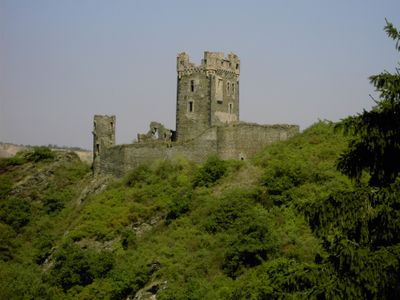
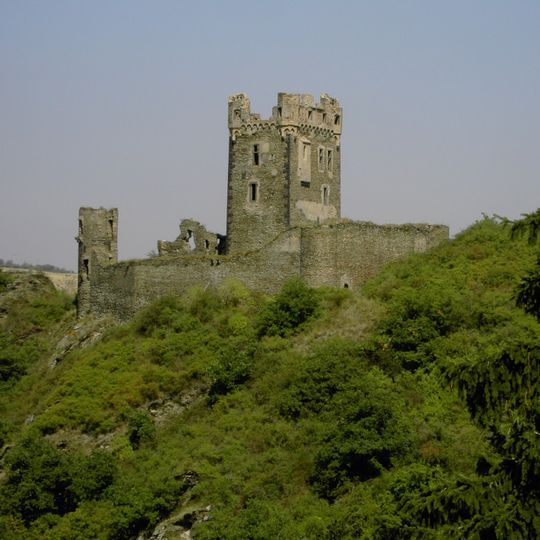
Burg Wernerseck is a medieval castle ruin near Ochtendung in Rhineland-Palatinate, built on a pentagonal plan with three round corner towers. The residential tower is the most visible part of what remains, rising well above the other walls while the whole site sits on a hillside above the Nette River.
Werner von Falkenstein, Archbishop of Trier, began building the castle in late 1401 during his expansion into the Pellenz. The site lay not in Electoral Trier territory but in the feudal area of the counts of Virneburg, and the border fortress against Cologne never served its purpose because the frontier shifted during construction. From the 16th century the castle was pledged to the lords of Eltz, who held it into the 19th century.
The name Wernerseck means "Werner's corner", after Werner von Falkenstein, the Trier archbishop who began the castle in 1401. The site is also called Kelterhausburg. From 1966 to 1969 a falconry was housed in the ruins, and today a preservation society maintains the tower house, renovated between summer 2006 and November 2007.
The ruins can be reached on foot from Ochtendung, and the path runs through hilly terrain, so sturdy shoes make the walk easier. Once at the site, the ground around the walls is uneven, so it is worth watching your step when exploring.
The castle's name means "Werner's corner", after its founder, Archbishop Werner of Falkenstein of Trier (1388–1418). The site was chosen on the narrowest point of a hill spur, where a Late Antique Roman refuge fort had stood since the first half of the 4th century; coin finds date that earlier fortification, and pottery suggests use into the early 5th century.
The community of curious travelers
AroundUs brings together thousands of curated places, local tips, and hidden gems, enriched daily by 94,522 contributors worldwide.