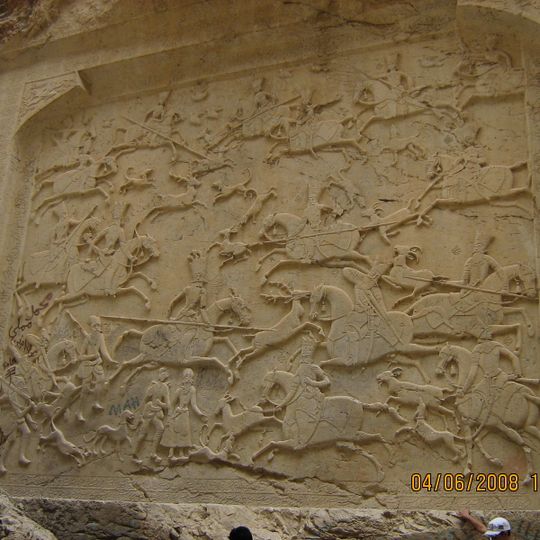
Tang-e Vashi relief, Rock relief in Shahrabad Rural District, Iran
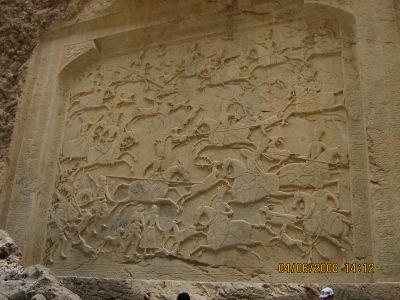
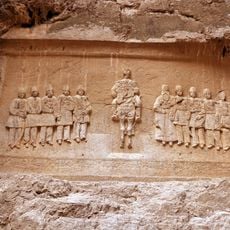
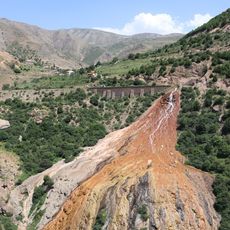
The Tang-e Vashi relief is a stone bas-relief carved into a rock face in the Shahrabad Rural District of Iran, roughly 26 feet (8 meters) wide and 20 feet (6 meters) tall. It sits on the vertical surface of a natural cliff inside a gorge, with figures carved directly onto the bare stone.
The relief was made in 1818 under the Qajar dynasty, when Persian rulers revived the ancient practice of carving scenes into cliff faces to commemorate royal events. This tradition stretches back to the Achaemenid and Sasanian periods, giving the Qajar work a deliberate link to earlier empires.
The relief shows a royal hunting or processional scene carved directly into the rock face, a tradition used in Iran for centuries to display royal power. Travelers passing through the gorge would have seen it as a clear sign of the ruler's presence in the region.
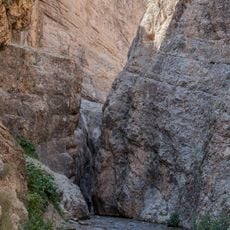
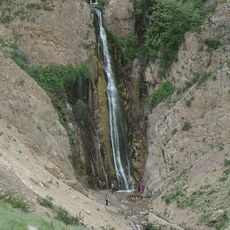
Reaching the relief requires a walk of several kilometers through a gorge over uneven ground, so sturdy footwear and water are important. There are no facilities at the site, and the terrain can be demanding, so visiting with someone familiar with the area is a good idea.
The gorge that holds the relief is one of two passages in the area, the other being Tang-e Saa, and the two are connected by the Savashi plain between them. This means visitors can walk through both gorges in a single trip, with the relief marking a natural midpoint along the way.
The community of curious travelers
AroundUs brings together thousands of curated places, local tips, and hidden gems, enriched daily by 90,755 contributors worldwide.