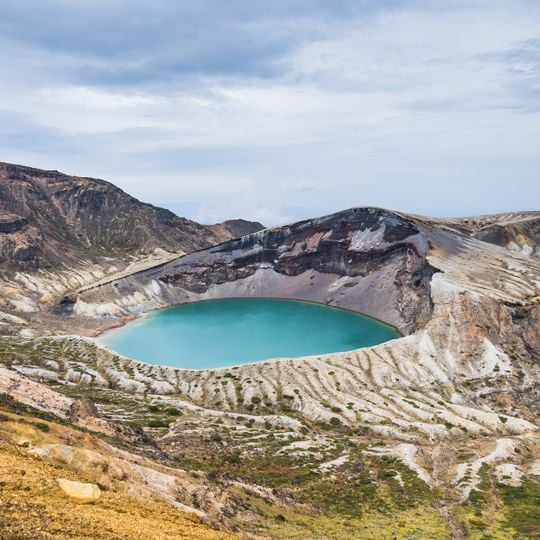
Okama, Volcanic crater lake in Mount Zao, Japan.
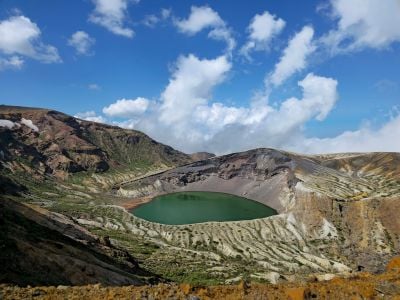
Okama is a crater lake about 400 metres wide at the bottom of an explosion crater on the western flank of Goshiki-dake, a central cone inside the Zaō caldera. The 1968 survey measured both diameters at 325 metres, maximum depth 27.6 metres and shoreline 1,080 metres. Its opaque water lies in a steep-walled basin ringed by pale ashen gravel, dark brown and reddish rock, and slopes scored by erosion channels.
The caldera formed when the mountain collapsed about 30,000 years ago; between roughly 3,000 and 2,000 years ago the eastern rim gave way, leaving the C-shaped or horseshoe outline. The central cone Goshiki-dake, 1,674 m high, grew inside the rim from about 2,000 years ago, and the present crater, about 800 years old, holds the lake. A map drawn around 1702 already shows water, and the volcano last erupted in 1918, when fumaroles appeared at the lake.
Local people call the crater Goshikinuma, which means Lake of Five Colors, because the water changes hue depending on weather conditions. On sunny days the surface glows turquoise green, while fog or rain brings out gray and blue tones that make the water look like liquid metal.
The viewpoint is accessible via the Zao Echo Line road, which opens from late April to early November when snow does not block the route. Visitors can take a chair lift from the lower parking area or walk the short trail up to the crater rim, where the view over the water is unobstructed.
The lake's water is strongly acidic, with a pH of 3.5, and no living organisms inhabit it. Its depth has been recorded since 1908, when it was about 50 meters; by 1939, after volcanic activity, it reached 63 meters. In 2022, a skier died after breaking through ice on the frozen surface, as entry to the surrounding area is restricted.
The community of curious travelers
AroundUs brings together thousands of curated places, local tips, and hidden gems, enriched daily by 94,051 contributors worldwide.