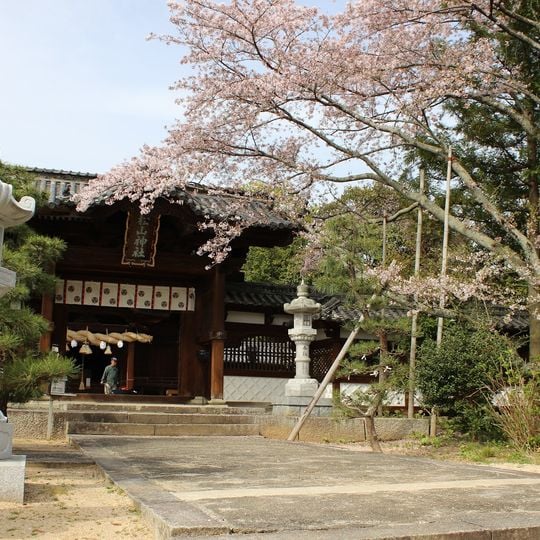
松山神社, Shinto shrine in Japan
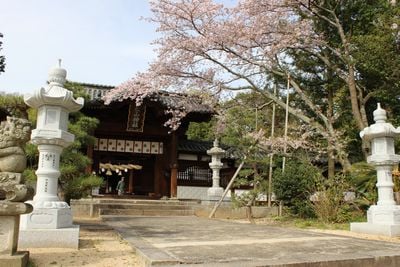
Matsuyama Tōshō-gū is a Shinto shrine in Matsuyama whose worship hall, stone-floored connecting section and main hall form a single structure in the ishi-no-ma-zukuri style. The present buildings date from 1865, when the shrine was rebuilt. In 2021 five of its buildings were designated tangible cultural properties of Ehime Prefecture.
The shrine was founded in 1618, when Matsuyama lord Katō Yoshiaki built a small hall within the grounds of Yuzuki Hachimangū to honour Tokugawa Ieyasu. In 1768, under the eighth Matsudaira lord Sadakiyo, a temporary shrine was completed for the 150th anniversary of Ieyasu's death. The present hall was rebuilt in 1865 for the 250th anniversary, and in 1910 the shrine absorbed Yuzuki Tenmangū and took the name Matsuyama Shrine.
The shrine honors Sugawara no Michizane, a scholar believed to bring good fortune for studies and success. Visitors notice the Mitsuba Aoi plant symbols throughout the grounds, which connect the place to the Tokugawa family and give it a unified appearance.
The shrine is a ten-minute walk from Dogo Onsen Station on the Iyo Railway city tram line, where the Botchan Train also stops. The precinct lies near Dogo Onsen Honkan, Dogo shopping street and Dogo Park. The main hall, stone chamber, worship hall, Chinese-style gate, lattice fence, offering hall and rear gate were registered as Matsuyama City historic sites in 2004.
The shrine's portable mikoshi carries the Tokugawa family crest, the three-leaf hollyhock, and the adult mikoshi was restored in 2010 after 43 years out of use. It is carried into the main hall on the evening of 5 October during the autumn festival.
The community of curious travelers
AroundUs brings together thousands of curated places, local tips, and hidden gems, enriched daily by 94,097 contributors worldwide.