Bannosu Viaduct, Road-rail truss viaduct in Sakaide, Kagawa, Japan
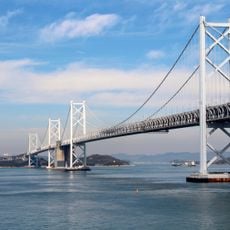
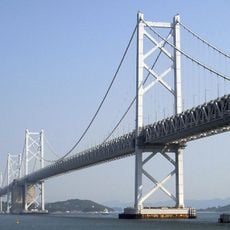
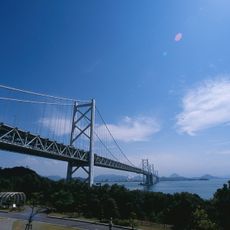
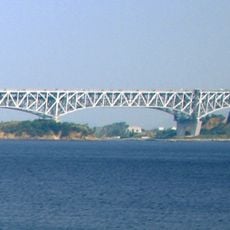
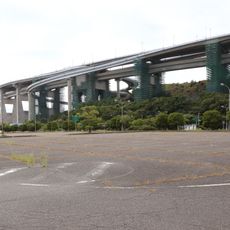
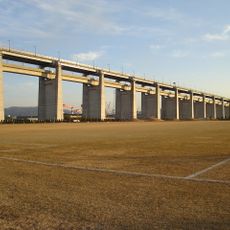
The Bannosu Viaduct is a 2,939 m double-deck truss viaduct at the southern end of the Seto Ohashi crossing, linking the Minami Bisan-Seto Bridge to the Shikoku land section. The Seto-Chuo Expressway runs on the upper deck and the Honshi-Bisan Line (Seto Ohashi Line) on the lower. Its three-span curved-chord Warren truss bends at the intermediate main-truss supports to follow a curve in plan.
Construction of the Bannosu Viaduct began in 1980 and it was completed in 1985, forming the southernmost bridge of the Seto Ohashi crossing. It links the Minami Bisan-Seto Bridge to the Shikoku land section and carries both the Seto-Chuo Expressway and the Honshi-Bisan Line.
The viaduct carries the Seto-Chuo Expressway on its upper deck and the Honshi-Bisan Line (Seto-Ohashi Line) below, so trains and cars cross side by side. Its three-span truss bends at the intermediate support points to follow a curve in plan, and the long spans use a curved-chord Warren truss.
The viaduct carries the Seto-Chuo Expressway on its upper deck and the Honshi-Bisan (Seto-Ohashi) Line below, so drivers and train passengers cross the same structure. It runs about 3 km from the Minami Bisan-Seto Bridge to the Shikoku land section, and the deck curves in plan, bending at the intermediate truss supports.
Despite not carrying "Bridge" in its name, the Bannosu Viaduct is the longest structure in the Great Seto Bridge network at 2,939 m. Its deck curves in plan, so the main truss is bent at the intermediate support points, and the long spans use a curved-chord Warren truss.
The community of curious travelers
AroundUs brings together thousands of curated places, local tips, and hidden gems, enriched daily by 93,445 contributors worldwide.