Nabeshima Lighthouse, Maritime navigation lighthouse on Nabeshima Island, Sakaide, Japan
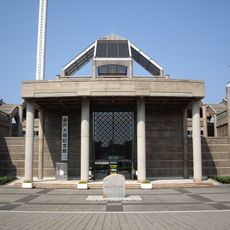
Nabeshima Lighthouse is a maritime navigation light on an island in Sakaide featuring six round stone columns on its facade. The building was constructed from granite sourced from the neighboring Yoshima Island.
Nabeshima Lighthouse was first lit on 15 November 1872, making it the first lighthouse built in the Seto Inland Sea; it was designed by Richard Henry Brunton, the Scottish engineer known as the father of Japanese lighthouses. Its original light was a double-wick vegetable-oil lamp with a fixed white beam of 500 candela. In 1921 the light became a rotating red-green alternating apparatus in a mercury bath, and in 1962 a 100 V 300 W generator electrified it. It was automated in 1991 and designated a National Important Cultural Property on 12 December 2022.
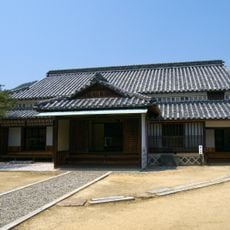
The lighthouse's top carries a weather vane whose direction markers are written in kanji — 東西南北 for east, west, south and north — rather than the usual Latin letters. The keepers' quarters, storehouse, three cisterns and a sundial, all designed by Brunton and finished in 1873, were moved to Shikoku Mura in Takamatsu in 1998.
The interior follows a Western floor plan with a central hallway, while bathing and toilet facilities are positioned in separate structures outside the main building. Visitors should expect these facilities to be separate from the main living areas.
The weather vane atop the lantern shows the cardinal directions in kanji (東西南北) rather than the usual Latin letters, a detail visible only from close range. The lighthouse itself is closed to the public except in April, when it opens during the cherry blossom season; in 2006 the coast guard opened it on 8–9 April alongside the flowering trees.
The community of curious travelers
AroundUs brings together thousands of curated places, local tips, and hidden gems, enriched daily by 93,478 contributors worldwide.